
26 · Writing Better Tools for AI Agents
What makes a tool reliable and production-ready.
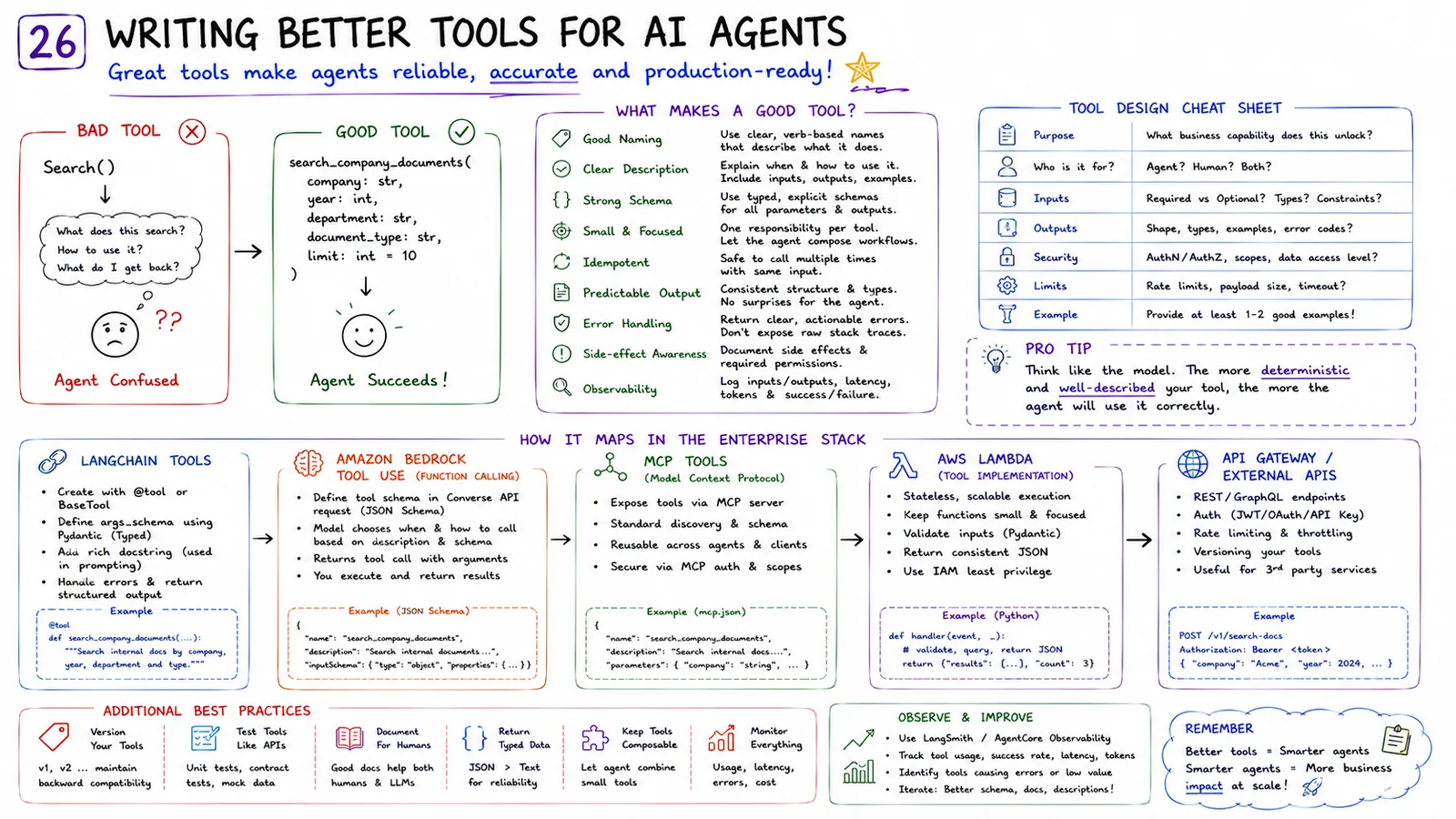
Great tools make agents reliable, accurate and production-ready. This compares a bad tool to a good tool and gives a cheat sheet for designing tools agents can use correctly.
In simple terms
Well-designed, well-described tools are what make agents actually work.
How it works
- 1A bad tool (e.g. a vague Search()) leaves the agent confused about inputs and outputs.
- 2A good tool has clear naming, a strong schema, and is small and focused.
- 3Define the tool with types and examples (Pydantic/JSON schema).
- 4Make it idempotent, with predictable output and good error handling.
- 5The agent then calls it correctly and succeeds.
Key points
- Good tools: clear name, clear description, strong schema, small and focused, idempotent.
- Tool design cheat sheet: purpose, who it's for, inputs, outputs, security, limits, examples.
- The more deterministic and well-described a tool, the more reliably the agent uses it correctly.
- Better tools = smarter agents = more business impact at scale.
Why it matters
Agents are only as good as their tools. Clear, well-typed, well-documented tools are the difference between an agent that works and one that constantly fails.
Frequently asked questions
- What makes a good tool?
- Clear naming and description, a typed schema, focused scope, idempotency and predictable, well-handled output.
- Why does tool description matter?
- The model chooses and calls tools from their descriptions — clearer descriptions mean fewer wrong calls.
More in Production AI Stack (2026)
1 · The Big Picture
The complete end-to-end production AI stack (2026).
2 · User Request Lifecycle
How one request flows through the whole system.
3 · LangChain Ecosystem
How LangChain, LangGraph, LangServe and LangSmith fit together.
4 · LangGraph Orchestration
Stateful, multi-step agent workflows.
5 · AWS Bedrock Integration
How LangChain talks to models through Amazon Bedrock.
6 · Amazon AgentCore
The enterprise runtime for LangChain/LangGraph agents.