
Optimized Enterprise RAG — Final Architecture
All optimizations working together.
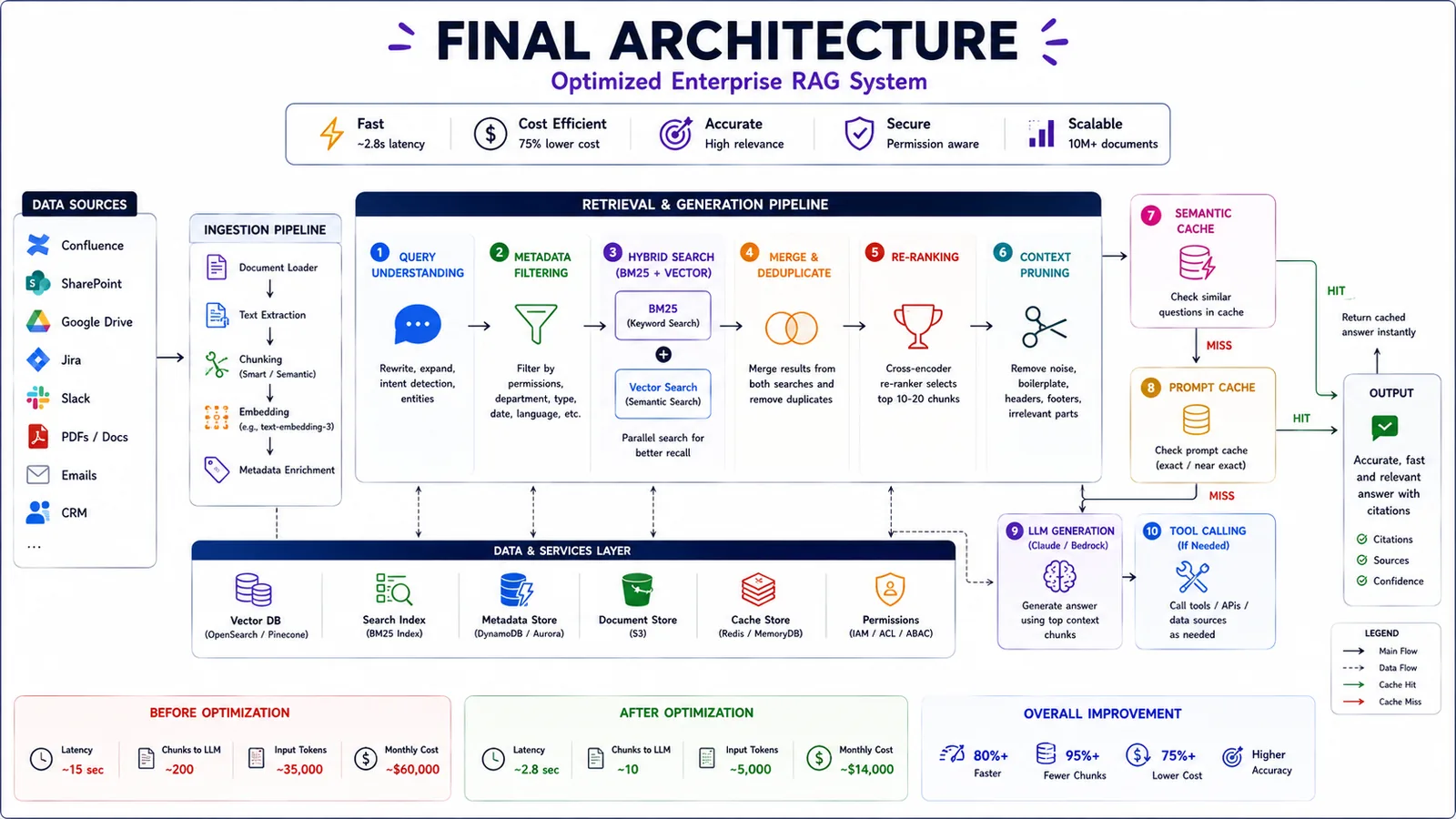
This is the final architecture of an optimized enterprise RAG system, combining all the optimizations — hybrid search, reranking, context pruning, semantic and prompt caching — into one fast, cost-efficient, accurate pipeline.
In simple terms
All RAG optimizations combined into one production architecture.
How it works
- 1Data sources (Confluence, SharePoint, Drive, Jira, Slack, PDFs, email, CRM) feed an ingestion pipeline.
- 2The pipeline chunks, embeds and enriches with metadata.
- 3Retrieval & generation: query understanding → metadata filter → hybrid search → merge/dedup → rerank → context pruning.
- 4Semantic cache and prompt cache short-circuit repeated queries.
- 5The LLM generates a grounded, cited answer; tools are called as needed.
Key points
- Combines hybrid search, reranking, pruning, semantic cache and prompt cache.
- Typical improvement: ~80% faster, ~95% fewer chunks, ~75% lower cost, higher accuracy.
- Permission-aware and secure, scalable to millions of documents.
- Observability and evaluation run across the pipeline.
Why it matters
Seeing all optimizations together shows how a production RAG system becomes fast, cheap and accurate — the payoff of applying each technique in sequence.
Frequently asked questions
- What do the optimizations achieve together?
- Big gains: far fewer chunks to the LLM, much lower latency and cost, and higher accuracy.
- What are the two cache layers?
- A semantic cache (similar questions) and a prompt cache (exact/near-exact prompts).
More in RAG & Retrieval (Enterprise)
Where Hallucinations Come From
Failures across the query, retrieval and model layers.
RAG Retrieval Optimization Layer
Retrieve the right context with high recall and relevance.
RAG: Retrieval Re-ranking
Re-rank retrieved docs to keep only the most relevant.
RAG Optimization 1 · Hybrid Search
Keyword + semantic search for higher recall.
RAG Optimization 2 · Re-ranking
Find the most relevant docs before the LLM.
RAG Optimization 3 · Context Pruning
Remove noise; keep only what matters.