
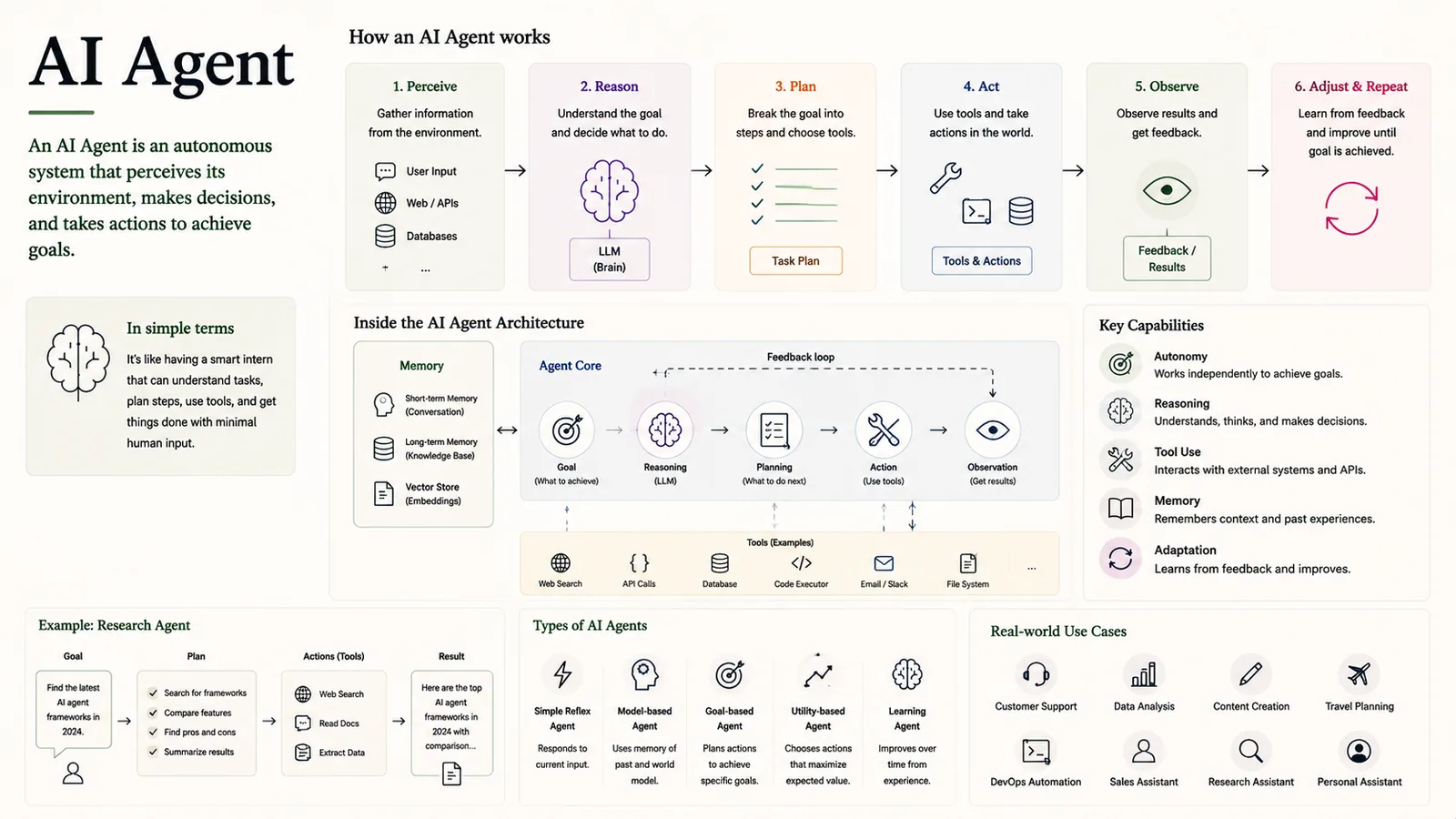
An AI Agent is an autonomous system that perceives its environment, makes decisions and takes actions to achieve goals. Unlike a one-shot chatbot, an agent plans, uses tools, observes results and iterates until the goal is met.
In simple terms
A smart system that can understand tasks, plan steps, use tools and get things done with minimal human input.
How it works
- 1Perceive: gather information from the environment (user input, web, APIs, databases).
- 2Reason: understand the goal and decide what to do (the LLM is the brain).
- 3Plan: break the goal into steps and choose tools.
- 4Act: use tools and take actions in the world.
- 5Observe: observe results and get feedback.
- 6Adjust & repeat: learn from feedback and improve until the goal is achieved.
Key points
- Agent core = goal + reasoning (LLM) + planning + action + observation.
- Uses memory: short-term (conversation), long-term (knowledge base) and vector stores.
- Interacts with tools: web search, code, databases, email and more.
- Types include simple reflex, model-based, goal-based, utility-based and learning agents.
Why it matters
Agents move AI from answering questions to accomplishing tasks. By combining reasoning, tools and a control loop, they can carry out multi-step work like research, automation and coding.
Frequently asked questions
- What makes something an 'agent' vs a chatbot?
- An agent plans, uses tools, observes results and loops toward a goal, rather than replying once.
- Why do agents need memory?
- To keep context and task state across steps and sessions, so multi-step work stays coherent.
More in Agents, Tools & Protocols
LangChain
A framework for building LLM-powered applications.
MCP (Model Context Protocol)
The universal adapter connecting AI to tools and data.
WebMCP (Web Model Context Protocol)
MCP for the web — AI in the browser using online tools.
Fine Tuning
Adapt a pre-trained model to your specific data and task.
Fine-Tuning (Deep Dive)
The full fine-tuning workflow and hyperparameters.
Loop Engineering
Feedback loops that make AI outputs improve over time.