
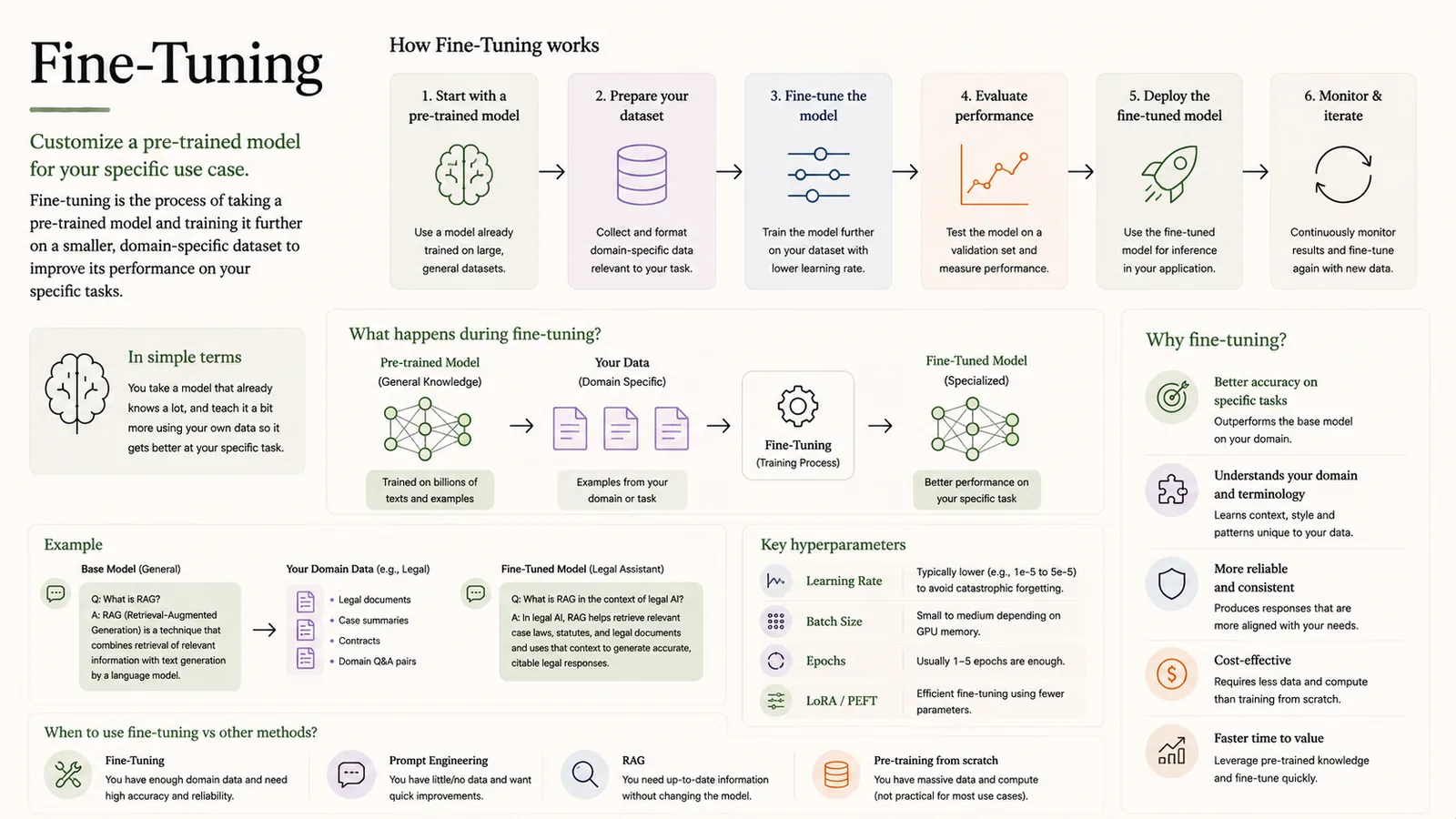
Fine-tuning is the process of taking a pre-trained model and training it further on a smaller, domain-specific dataset to improve its performance on your specific tasks. This deeper look covers the full workflow and the key settings that matter.
In simple terms
Take a model that already knows a lot, and teach it your domain with a focused dataset.
How it works
- 1Start with a pre-trained model already trained on large, general datasets.
- 2Prepare your dataset — collect and format domain-specific data.
- 3Fine-tune the model further on your dataset with a lower learning rate.
- 4Evaluate performance on a validation set.
- 5Deploy the fine-tuned model for inference.
- 6Monitor and iterate — fine-tune again with new data as needed.
Key points
- Key hyperparameters: learning rate (lower, e.g. 1e-5 to 5e-5), batch size, epochs (usually 1–5), and LoRA/PEFT for efficiency.
- Use fine-tuning when you have enough domain data and need high quality and reliability.
- Prompt engineering is faster if you only need small improvements.
- Use RAG when you need up-to-date information without changing the model.
Why it matters
Understanding fine-tuning's workflow and hyperparameters helps you decide when it's worth it versus prompting or RAG — and how to do it efficiently with methods like LoRA.
Frequently asked questions
- What is LoRA/PEFT?
- Parameter-efficient fine-tuning methods that tune a small number of extra weights, making fine-tuning cheaper and faster.
- How many epochs should I train?
- Usually 1–5. Too many risks overfitting (catastrophic forgetting of general ability).
More in Agents, Tools & Protocols
AI Agent
An autonomous system that perceives, reasons and acts.
LangChain
A framework for building LLM-powered applications.
MCP (Model Context Protocol)
The universal adapter connecting AI to tools and data.
WebMCP (Web Model Context Protocol)
MCP for the web — AI in the browser using online tools.
Fine Tuning
Adapt a pre-trained model to your specific data and task.
Loop Engineering
Feedback loops that make AI outputs improve over time.