
MCP (Model Context Protocol)
The universal adapter connecting AI to tools and data.
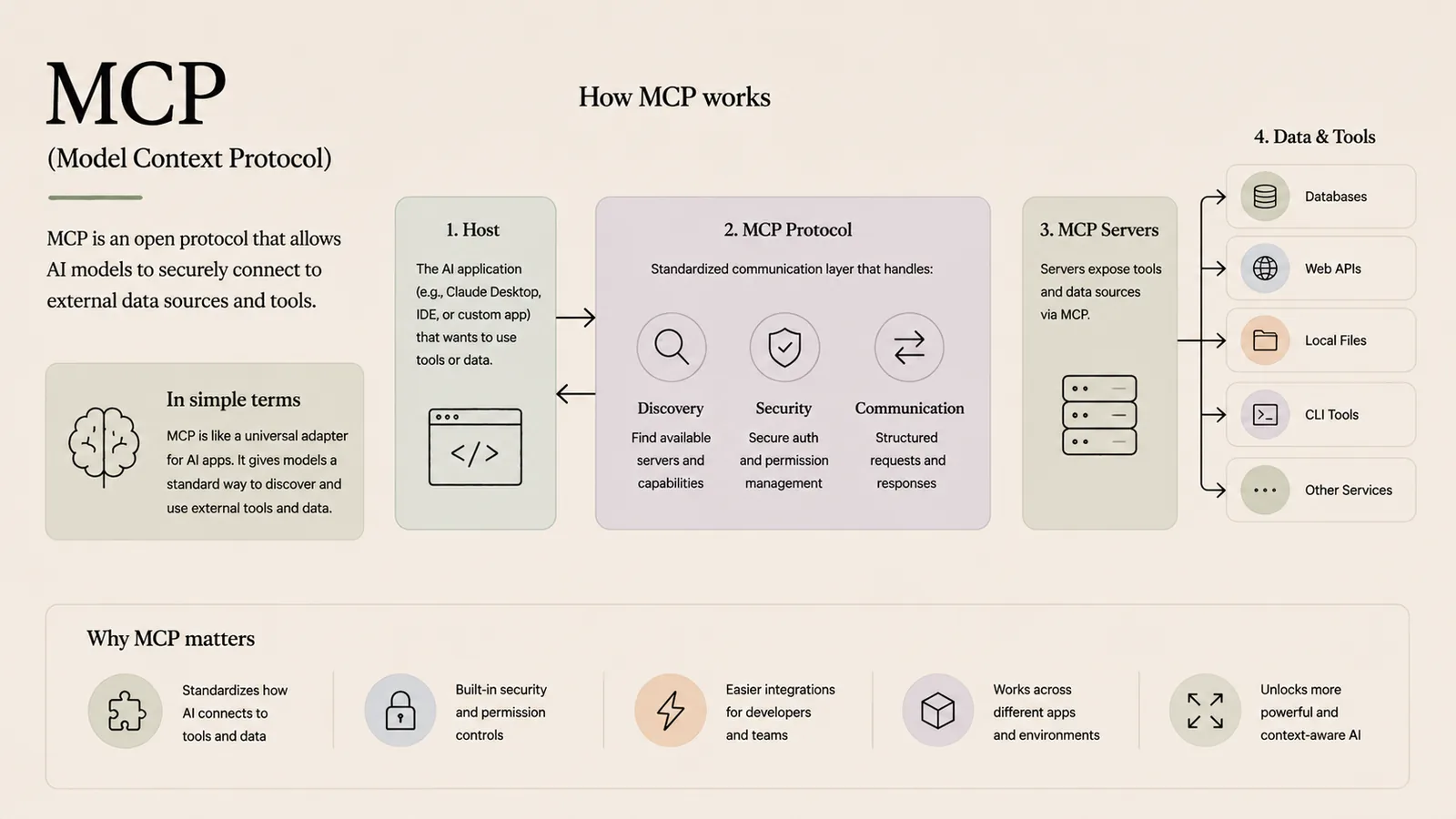
MCP (Model Context Protocol) is an open protocol that lets AI models securely connect to external data sources and tools. It's like a universal adapter, giving models a standard way to discover and use external tools and data.
In simple terms
MCP is a universal adapter for AI apps — one standard way to connect models to tools and data.
How it works
- 1Host: the AI application (e.g. Claude Desktop, an IDE or custom app) wants to use tools or data.
- 2MCP protocol: a standardized communication layer handles discovery, security and communication.
- 3MCP servers: servers expose tools and data sources via MCP.
- 4Data & tools: the model can reach databases, web APIs, local files, CLI tools and other services.
Key points
- Discovery: find available servers and their capabilities.
- Security: secure authentication and permission management.
- Communication: structured requests and responses.
- Standardises integrations so they aren't rebuilt for every app.
Why it matters
MCP removes the need to build a custom integration for every tool and app. A single standard means any MCP-compatible model can use any MCP server, making AI tooling reusable and secure.
Frequently asked questions
- What problem does MCP solve?
- It replaces one-off integrations with a shared standard, so tools and data connect to any MCP-aware app the same way.
- What can MCP connect to?
- Databases, web APIs, local files, CLI tools and other services, all through MCP servers.
More in Agents, Tools & Protocols
AI Agent
An autonomous system that perceives, reasons and acts.
LangChain
A framework for building LLM-powered applications.
WebMCP (Web Model Context Protocol)
MCP for the web — AI in the browser using online tools.
Fine Tuning
Adapt a pre-trained model to your specific data and task.
Fine-Tuning (Deep Dive)
The full fine-tuning workflow and hyperparameters.
Loop Engineering
Feedback loops that make AI outputs improve over time.