
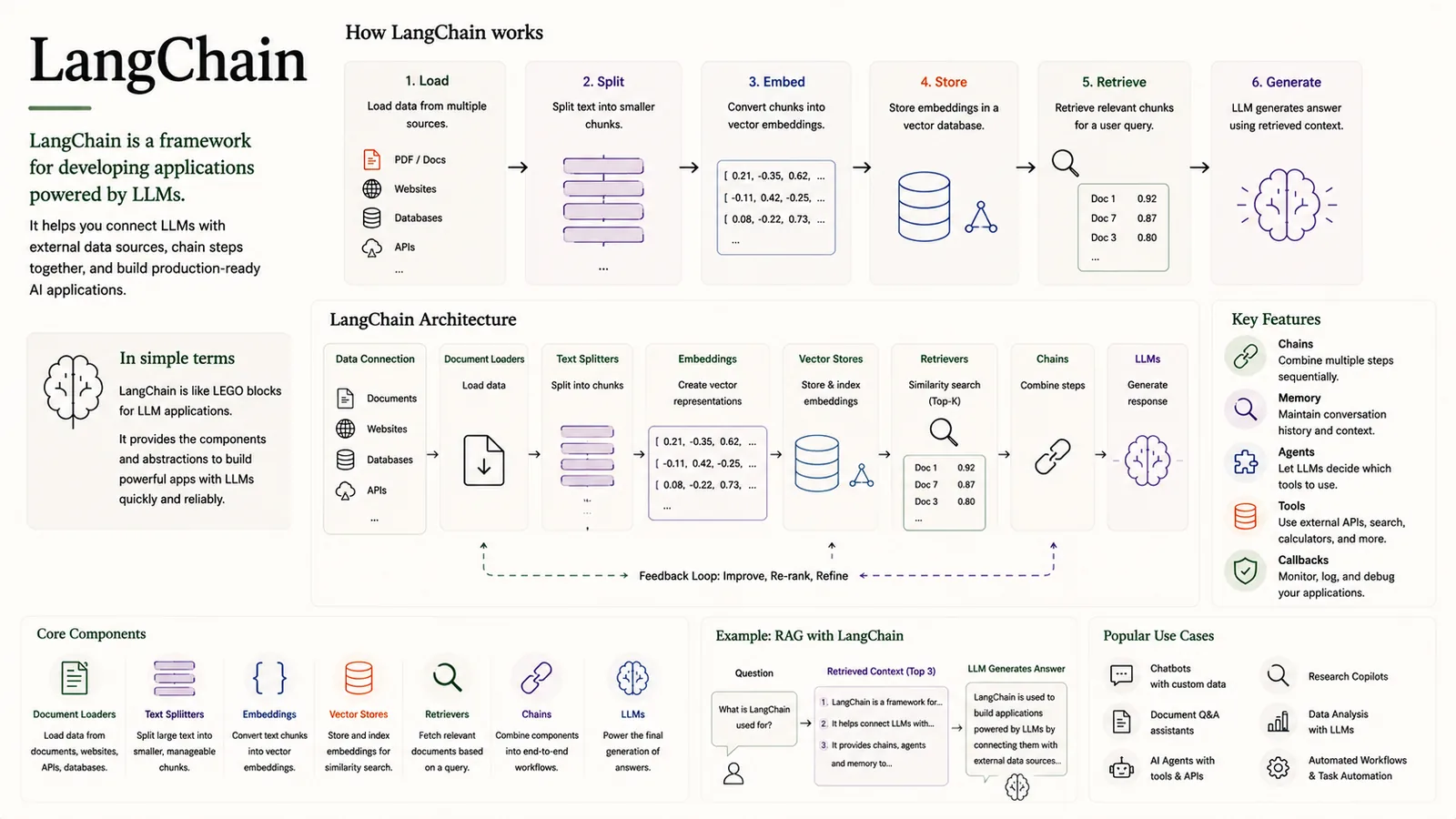
LangChain is a framework for developing applications powered by LLMs. It helps you connect models to external data, chain steps together and build production-ready AI applications — like LEGO blocks for LLM apps.
In simple terms
A toolkit of building blocks for connecting LLMs to data, tools and multi-step workflows.
How it works
- 1Load: load data from multiple sources (PDFs, websites, databases, APIs).
- 2Split: split text into smaller chunks.
- 3Embed: convert chunks into vector embeddings.
- 4Store: store embeddings in a vector database.
- 5Retrieve: retrieve relevant chunks for a user query.
- 6Generate: the LLM generates an answer using the retrieved context.
Key points
- Core components: document loaders, text splitters, embeddings, vector stores, chains and LLMs.
- Chains combine multiple steps sequentially.
- Supports memory, agents, tools and callbacks.
- Commonly used to build RAG apps, chatbots and automated workflows.
Why it matters
LangChain standardises the plumbing of LLM apps — loading data, chunking, embedding, retrieval and orchestration — so teams can build RAG systems and agents quickly and reliably.
Frequently asked questions
- What is a 'chain'?
- A sequence of steps (prompts, models, tools) wired together so the output of one feeds the next.
- Is LangChain only for RAG?
- No — it also builds chatbots, agents, tool-using apps and automated workflows.
More in Agents, Tools & Protocols
AI Agent
An autonomous system that perceives, reasons and acts.
MCP (Model Context Protocol)
The universal adapter connecting AI to tools and data.
WebMCP (Web Model Context Protocol)
MCP for the web — AI in the browser using online tools.
Fine Tuning
Adapt a pre-trained model to your specific data and task.
Fine-Tuning (Deep Dive)
The full fine-tuning workflow and hyperparameters.
Loop Engineering
Feedback loops that make AI outputs improve over time.