
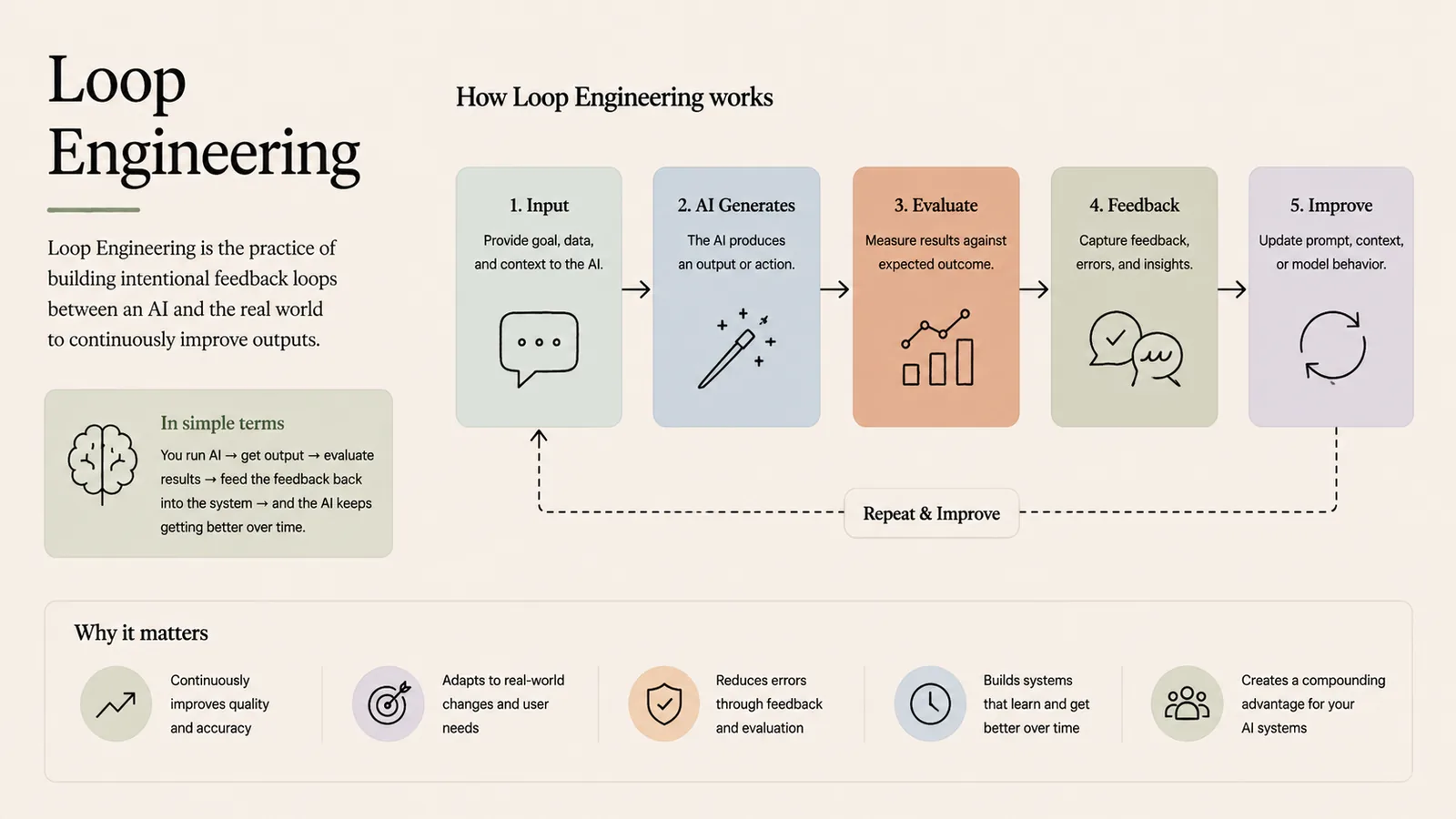
Loop Engineering is the practice of building intentional feedback loops between an AI and the real world to continuously improve outputs. You run the AI, evaluate results, feed the feedback back in, and the system keeps getting better.
In simple terms
Run AI → get output → evaluate → feed feedback back → the AI keeps improving.
How it works
- 1Input: provide goal, data and context to the AI.
- 2AI generates: the AI produces an output or action.
- 3Evaluate: measure results against the expected outcome.
- 4Feedback: capture feedback, errors and insights.
- 5Improve: update the prompt, context or model behaviour — then repeat.
Key points
- Continuously improves quality and accuracy.
- Adapts to real-world changes and user needs.
- Reduces errors through feedback and evaluation.
- Creates a compounding advantage for your AI systems over time.
Why it matters
AI systems that don't measure and iterate stay static. Loop engineering builds the evaluate-and-improve cycle that turns a one-off model into a system that gets better with use.
Frequently asked questions
- How is this different from just prompting?
- It adds a deliberate measure-and-improve loop, so quality rises over time instead of staying fixed.
- What do I measure?
- Whatever defines success — accuracy, user satisfaction, errors, cost — then feed those signals back in.
More in Agents, Tools & Protocols
AI Agent
An autonomous system that perceives, reasons and acts.
LangChain
A framework for building LLM-powered applications.
MCP (Model Context Protocol)
The universal adapter connecting AI to tools and data.
WebMCP (Web Model Context Protocol)
MCP for the web — AI in the browser using online tools.
Fine Tuning
Adapt a pre-trained model to your specific data and task.
Fine-Tuning (Deep Dive)
The full fine-tuning workflow and hyperparameters.