
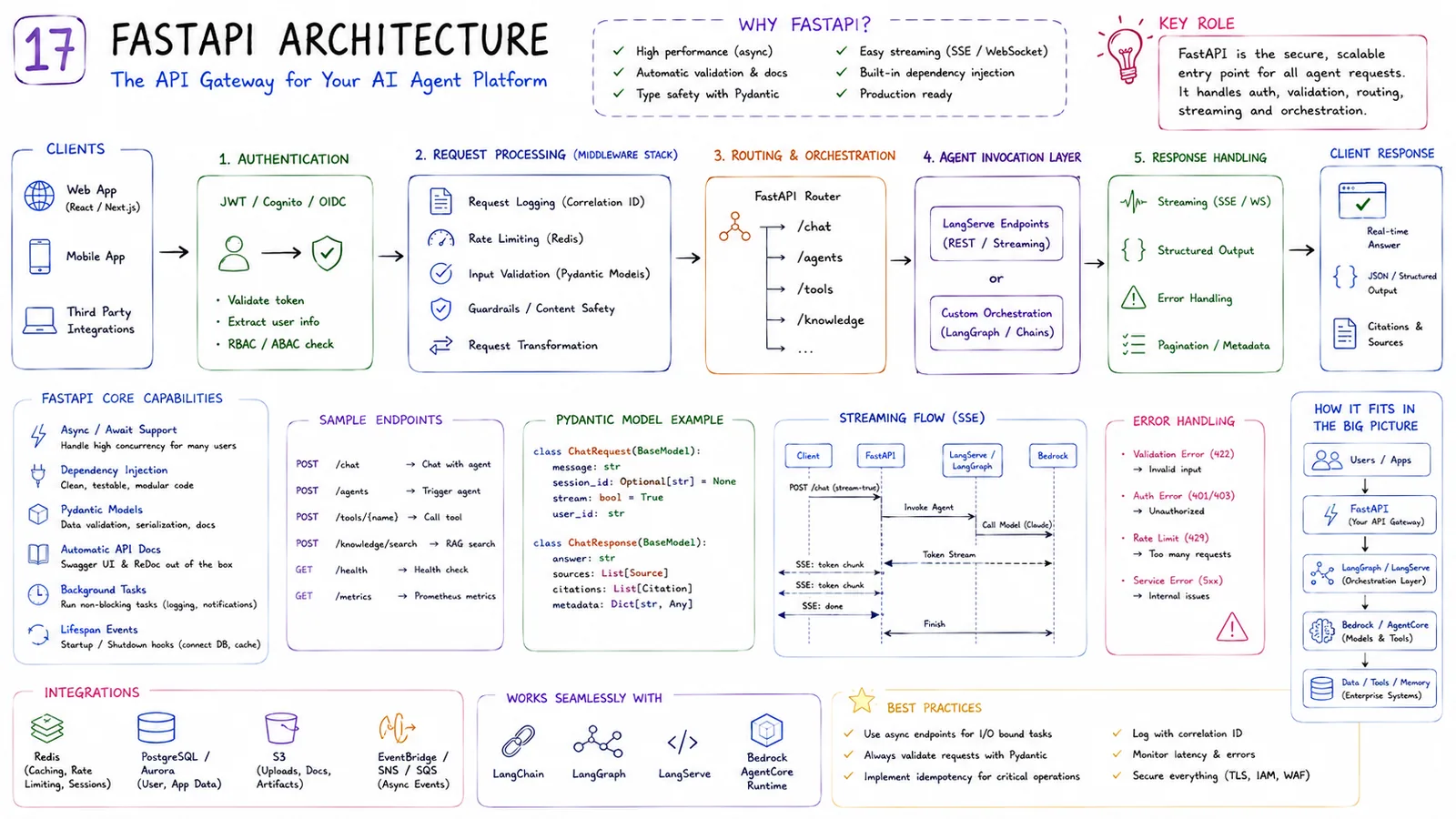
FastAPI is the API gateway for your AI agent platform. This diagram shows its role: the secure, scalable entry point that handles auth, validation, routing, streaming and orchestration.
In simple terms
The high-performance API layer that fronts your agents — auth, validation, routing and streaming.
How it works
- 1Clients (web, mobile, third-party) hit the FastAPI router.
- 2Authentication: JWT/Cognito/OIDC validates the request.
- 3Request processing: logging, rate limiting, input validation (Pydantic), guardrails.
- 4Routing & orchestration: route to LangServe endpoints or custom LangGraph chains.
- 5Response handling: streaming (SSE/WS), structured output and error handling.
Key points
- High performance and async; automatic API docs and type safety via Pydantic.
- Built-in dependency injection and background tasks.
- Integrates with Redis, Postgres/Aurora, S3, EventBridge and AgentCore.
- Best practices: async I/O, idempotency, correlation IDs, secure everything.
Why it matters
FastAPI is where every request enters your AI system, so it's where security, validation and streaming are enforced. A solid gateway keeps the whole platform reliable and safe.
Frequently asked questions
- Why FastAPI for AI apps?
- It's high-performance, async, type-safe with Pydantic, and streams responses — ideal for LLM APIs.
- What does it validate?
- Auth tokens and request bodies (via Pydantic models), with rate limiting and guardrails before orchestration.
More in Production AI Stack (2026)
1 · The Big Picture
The complete end-to-end production AI stack (2026).
2 · User Request Lifecycle
How one request flows through the whole system.
3 · LangChain Ecosystem
How LangChain, LangGraph, LangServe and LangSmith fit together.
4 · LangGraph Orchestration
Stateful, multi-step agent workflows.
5 · AWS Bedrock Integration
How LangChain talks to models through Amazon Bedrock.
6 · Amazon AgentCore
The enterprise runtime for LangChain/LangGraph agents.