
16 · Multi-Agent Patterns
Supervisor, parallel, sequential and debate patterns.
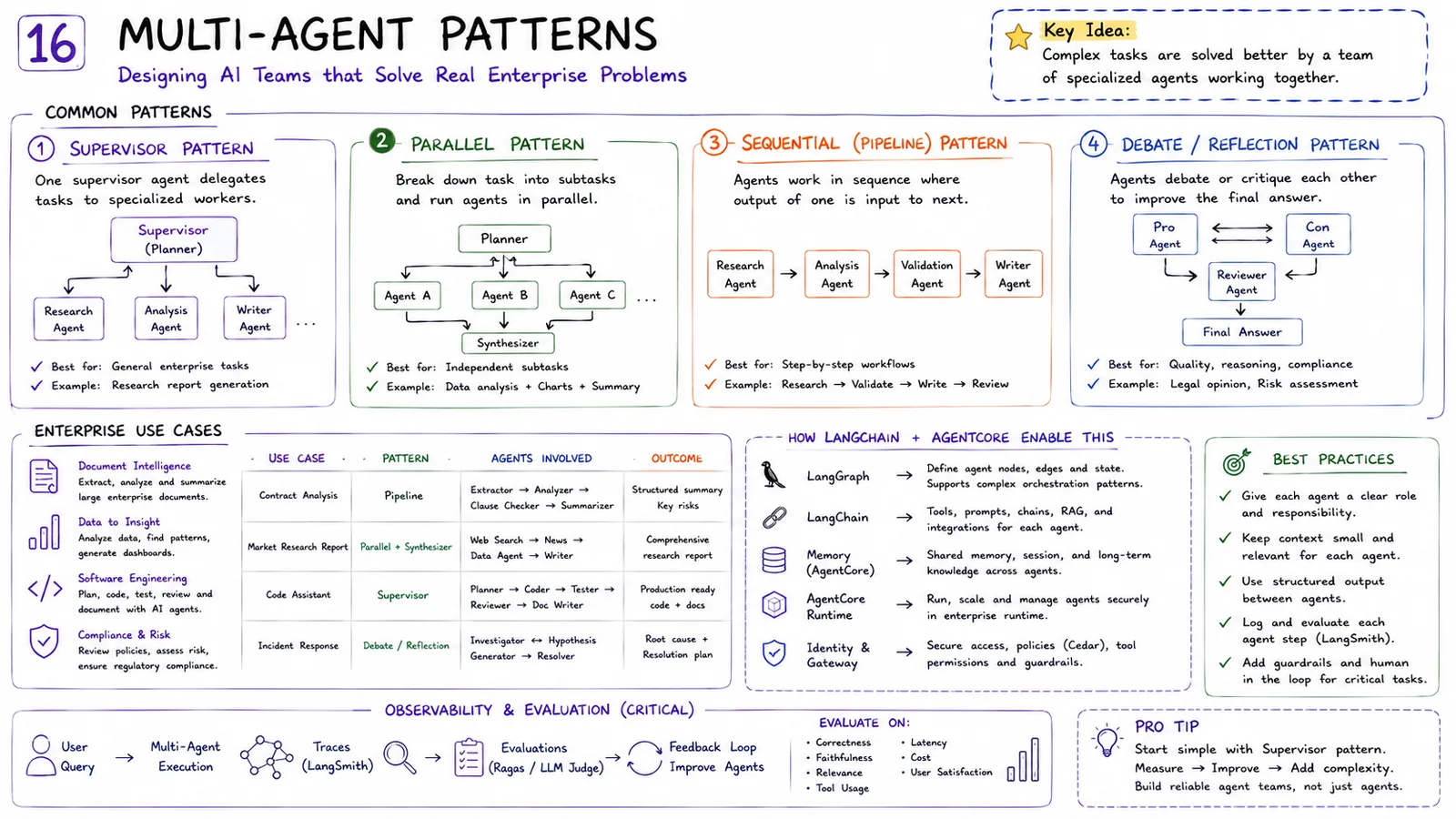
This designs AI teams that solve real enterprise problems using multi-agent patterns. Complex tasks are solved better by a team of specialized agents working together.
In simple terms
Four patterns — supervisor, parallel, sequential and debate — for teams of specialized agents.
How it works
- 1Supervisor pattern: one planner delegates tasks to specialized workers.
- 2Parallel pattern: break work into subtasks and run agents in parallel, then synthesize.
- 3Sequential (pipeline) pattern: each agent's output feeds the next.
- 4Debate/reflection pattern: agents critique each other to improve the final answer.
Key points
- LangGraph defines agent nodes, edges and state; AgentCore secures and scales them.
- Give each agent a clear role and use structured output between them.
- Log and evaluate every agent with LangSmith.
- Start simple (supervisor) and add complexity only when needed.
Why it matters
Multi-agent systems tackle problems a single agent can't — combining specialists for research, analysis, coding and review with higher quality and speed.
Frequently asked questions
- When do I need multiple agents?
- For complex, multi-domain goals that benefit from specialists; simple tasks are better with one agent.
- What's the safest starting pattern?
- The supervisor pattern — one planner delegating to a few specialists — then evolve from there.
More in Production AI Stack (2026)
1 · The Big Picture
The complete end-to-end production AI stack (2026).
2 · User Request Lifecycle
How one request flows through the whole system.
3 · LangChain Ecosystem
How LangChain, LangGraph, LangServe and LangSmith fit together.
4 · LangGraph Orchestration
Stateful, multi-step agent workflows.
5 · AWS Bedrock Integration
How LangChain talks to models through Amazon Bedrock.
6 · Amazon AgentCore
The enterprise runtime for LangChain/LangGraph agents.