
28 · Single vs Multi-Agent Systems
Choose the simplest architecture that solves the problem.
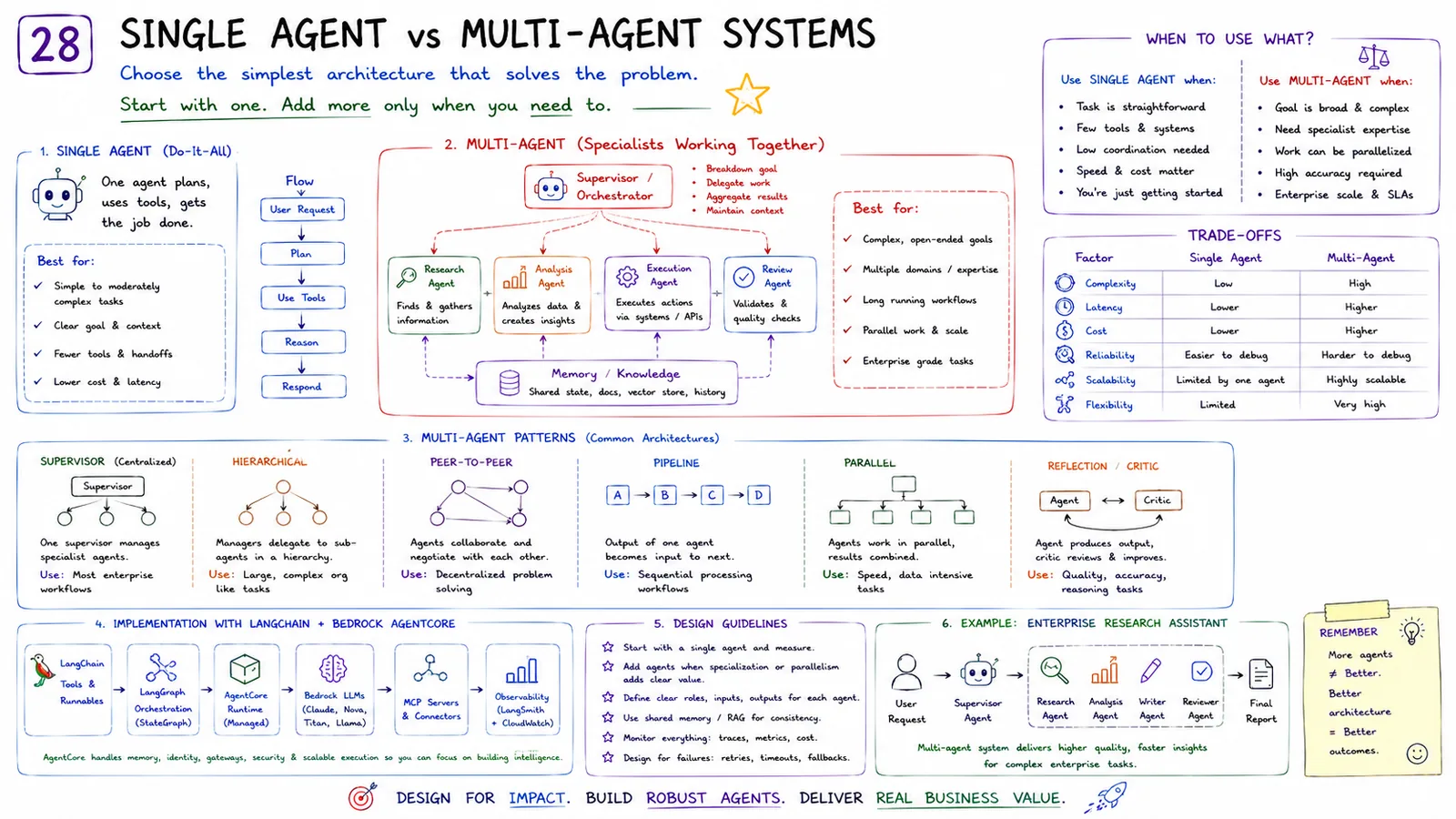
This helps you choose the simplest architecture that solves the problem: start with one agent and add more only when you need to. It compares single-agent and multi-agent systems and their trade-offs.
In simple terms
Start with a single agent; move to multi-agent only when the problem truly needs it.
How it works
- 1Single agent (do-it-all): one agent plans, uses tools and gets the job done.
- 2Multi-agent (specialists): a supervisor/orchestrator coordinates research, analysis, execution and review agents.
- 3Multi-agent patterns: supervisor (centralized), hierarchical, peer-to-peer, pipeline, parallel, reflection/critic.
- 4Design guidelines: start single, add specialization, give clear roles and structured output.
Key points
- Use single agent for simple/moderate tasks, few tools, low coordination.
- Use multi-agent for complex, multi-domain, long-running or high-accuracy work.
- Trade-offs: multi-agent adds latency, cost and complexity but scales specialization.
- Design for impact, not for a demo.
Why it matters
Over-engineering with many agents adds cost and fragility. Choosing single vs multi-agent deliberately keeps systems simple, debuggable and reliable.
Frequently asked questions
- When should I stay single-agent?
- For straightforward tasks with few tools and low coordination — it's simpler and cheaper to debug.
- What do multi-agent systems cost?
- More latency, tokens and complexity, in exchange for specialization and scale on complex goals.
More in Production AI Stack (2026)
1 · The Big Picture
The complete end-to-end production AI stack (2026).
2 · User Request Lifecycle
How one request flows through the whole system.
3 · LangChain Ecosystem
How LangChain, LangGraph, LangServe and LangSmith fit together.
4 · LangGraph Orchestration
Stateful, multi-step agent workflows.
5 · AWS Bedrock Integration
How LangChain talks to models through Amazon Bedrock.
6 · Amazon AgentCore
The enterprise runtime for LangChain/LangGraph agents.