
29 · Agent Design Patterns
Sequential, parallel, routing, supervisor, collaborative.
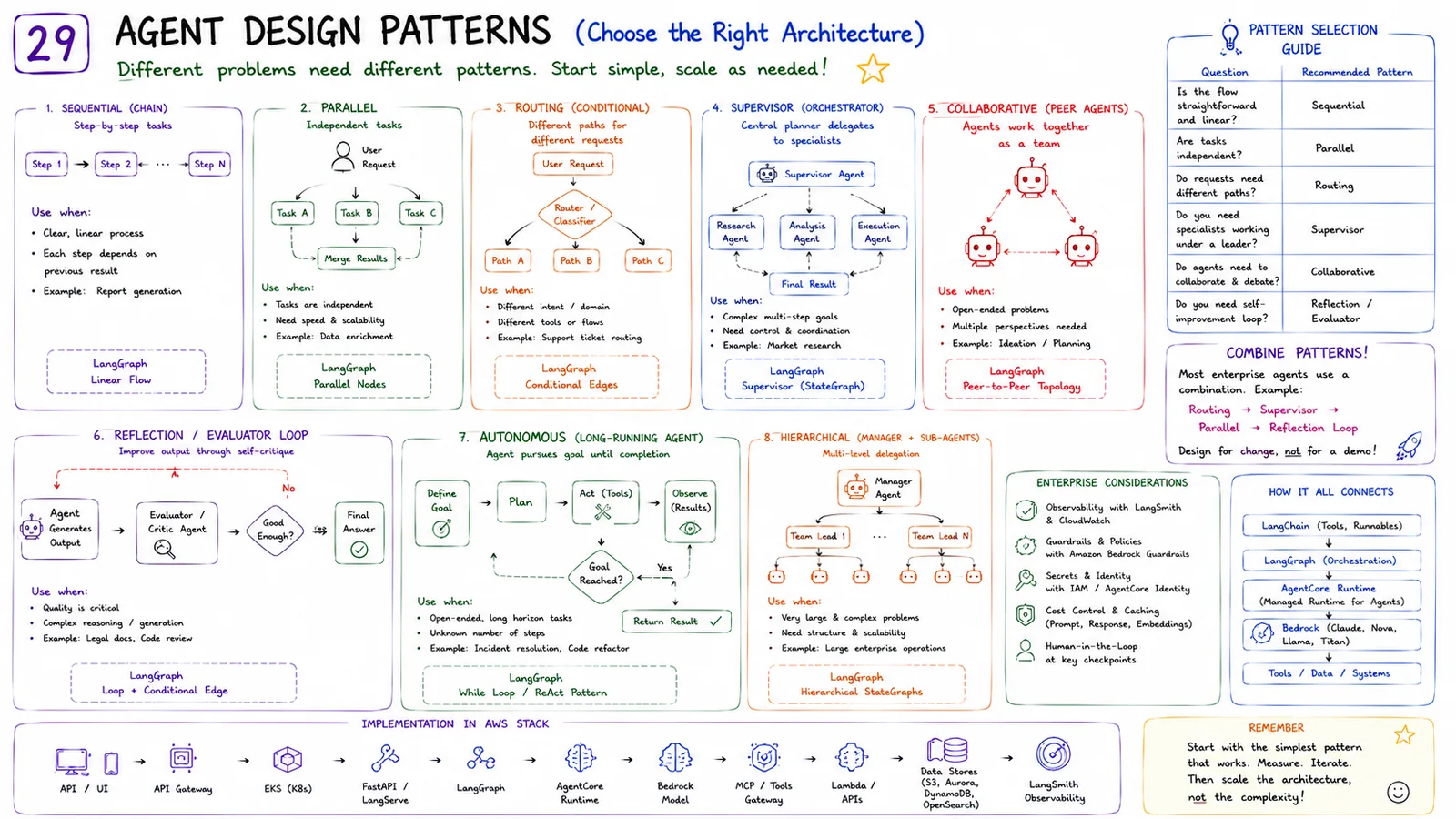
Different problems need different patterns. This catalogs agent design patterns and when to use each, so you start simple and scale as needed.
In simple terms
A menu of agent patterns — sequential, parallel, routing, supervisor, collaborative, reflection and more.
How it works
- 1Sequential (chain): step-by-step tasks where each step depends on the previous.
- 2Parallel: independent subtasks run at once, then merge.
- 3Routing (conditional): different requests take different paths.
- 4Supervisor (orchestrator): a central planner delegates to specialists.
- 5Collaborative, reflection/evaluator, autonomous and hierarchical patterns for harder problems.
Key points
- Use a selection guide: is the flow linear? are subtasks independent? do requests differ?
- Patterns can be combined (e.g. routing + supervisor + reflection).
- Implement in LangGraph on the AWS stack.
- Start with the simplest pattern that works, then iterate.
Why it matters
Matching the pattern to the problem avoids both over- and under-engineering. The right pattern makes an agent reliable, efficient and easier to maintain.
Frequently asked questions
- How do I pick a pattern?
- Ask whether the flow is linear, whether subtasks are independent, and whether requests need different paths — then match the pattern.
- Can patterns be combined?
- Yes — real systems often mix routing, supervisor and reflection patterns.
More in Production AI Stack (2026)
1 · The Big Picture
The complete end-to-end production AI stack (2026).
2 · User Request Lifecycle
How one request flows through the whole system.
3 · LangChain Ecosystem
How LangChain, LangGraph, LangServe and LangSmith fit together.
4 · LangGraph Orchestration
Stateful, multi-step agent workflows.
5 · AWS Bedrock Integration
How LangChain talks to models through Amazon Bedrock.
6 · Amazon AgentCore
The enterprise runtime for LangChain/LangGraph agents.