
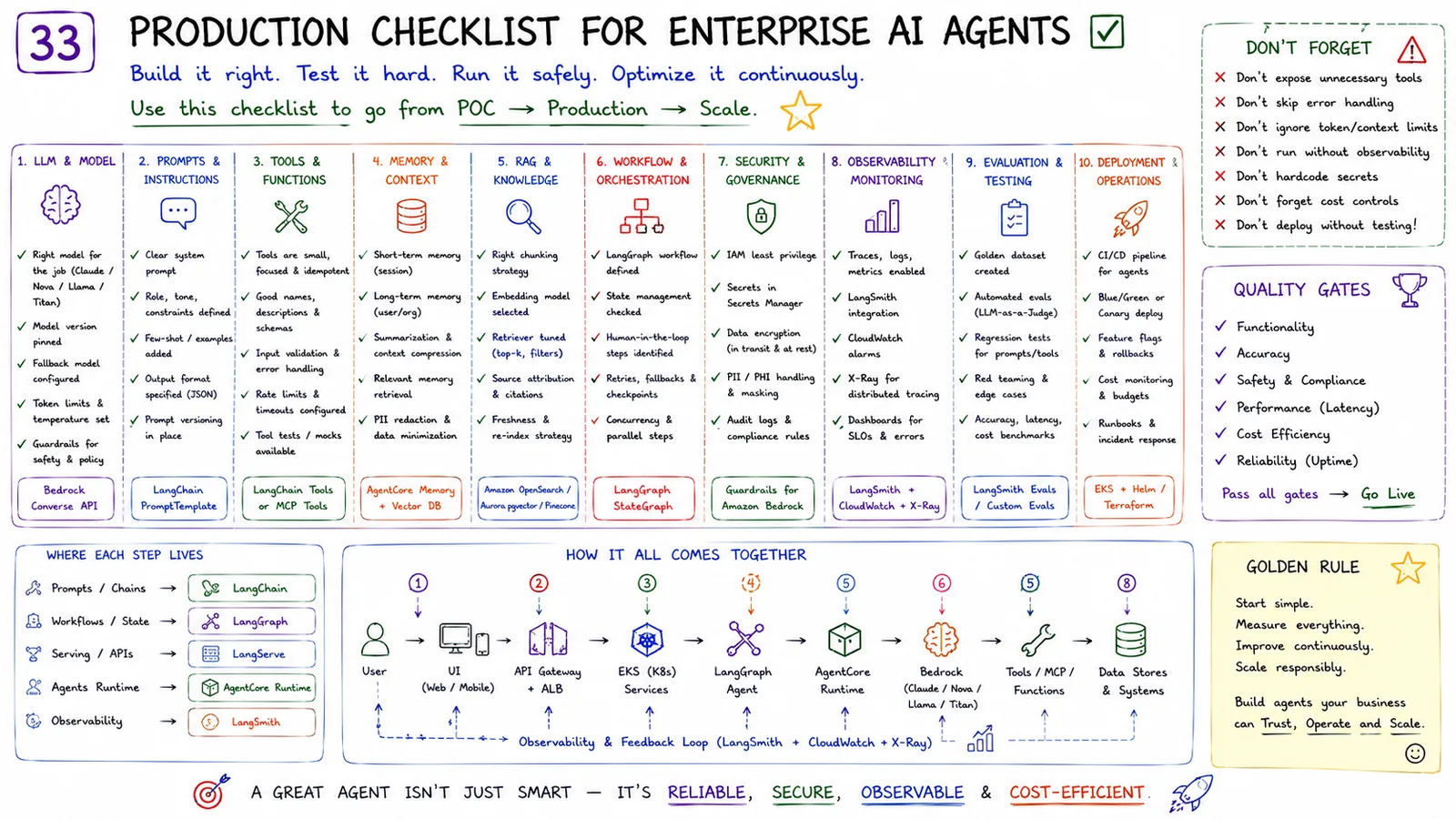
This is a production checklist for enterprise AI agents: build it right, test it hard, run it safely and optimize continuously. Use it to go from POC to production to scale.
In simple terms
A ten-point checklist to take an AI agent from proof-of-concept to reliable production.
How it works
- 1Pick the right model and configure prompts/instructions clearly.
- 2Design tools well and manage memory/context (short-term, long-term, RAG).
- 3Add workflow orchestration, security & governance, and observability/monitoring.
- 4Run evaluation & testing (golden datasets, regression tests) before deploying.
- 5Deploy with CI/CD and pass quality gates (functionality, accuracy, safety, latency, cost).
Key points
- Quality gates: functionality, accuracy, safety/compliance, performance, cost, reliability.
- Don't forget: cost controls, guardrails, observability and testing.
- Golden rule: start simple, measure everything, improve continuously, scale responsibly.
- A great agent isn't just smart — it's reliable, secure, observable and cost-efficient.
Why it matters
Most agents die between POC and production. A checklist ensures you cover security, evaluation, cost and reliability before shipping — the gap that separates demos from products.
Frequently asked questions
- What are quality gates?
- Pass/fail checks — functionality, accuracy, safety, performance, cost, reliability — before an agent goes live.
- What's the golden rule?
- Start simple, measure everything, improve continuously and scale responsibly.
More in Production AI Stack (2026)
1 · The Big Picture
The complete end-to-end production AI stack (2026).
2 · User Request Lifecycle
How one request flows through the whole system.
3 · LangChain Ecosystem
How LangChain, LangGraph, LangServe and LangSmith fit together.
4 · LangGraph Orchestration
Stateful, multi-step agent workflows.
5 · AWS Bedrock Integration
How LangChain talks to models through Amazon Bedrock.
6 · Amazon AgentCore
The enterprise runtime for LangChain/LangGraph agents.