
32 · Context Engineering
The right information, in the right form, at the right time.
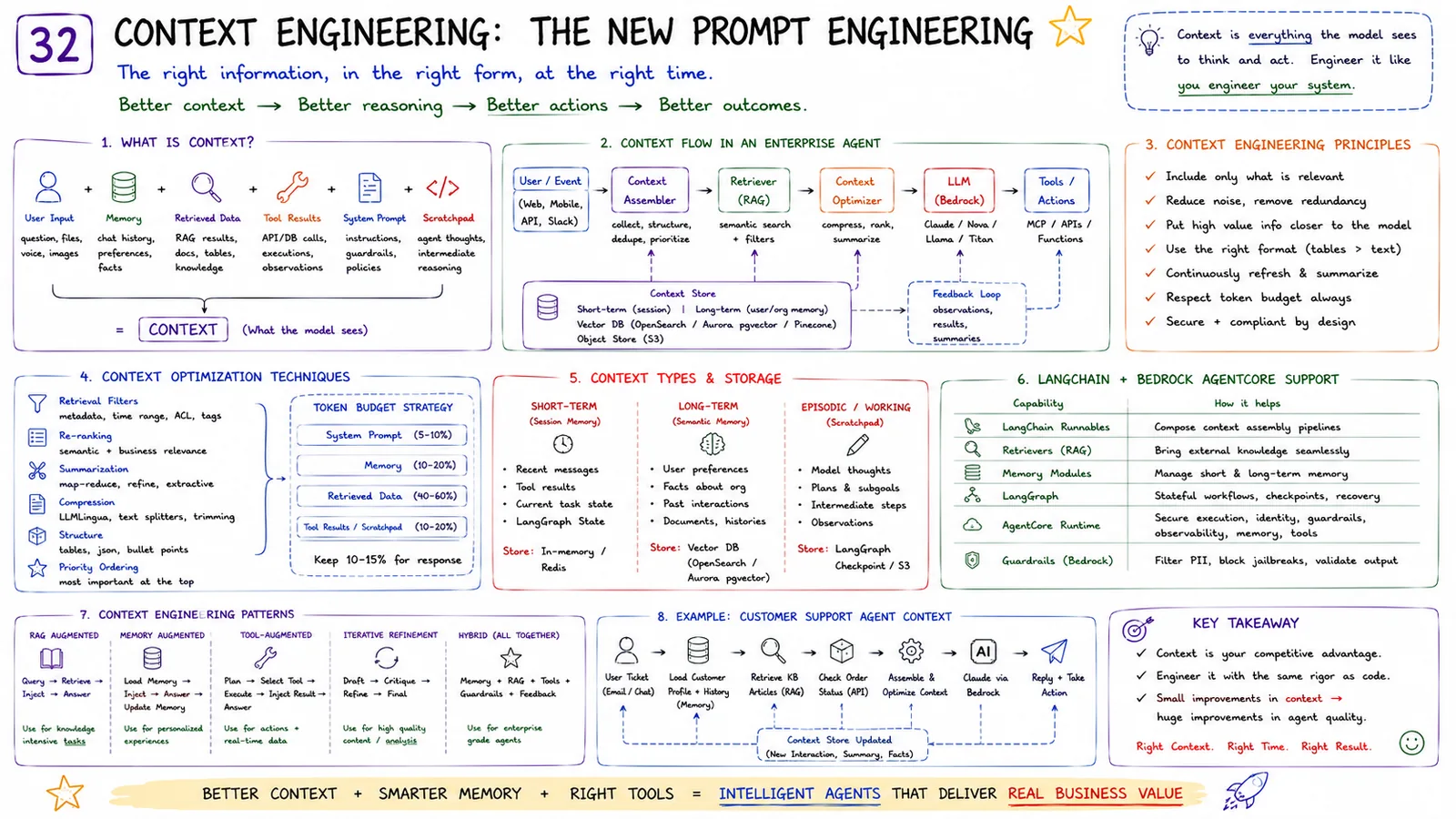
Context engineering is the new prompt engineering: getting the right information, in the right form, at the right time. Better context leads to better reasoning, actions and outcomes.
In simple terms
Engineer everything the model sees — context is what the model uses to think and act.
How it works
- 1Context is everything the model sees: user input, memory, retrieved data, tool results, system prompt.
- 2A context assembler collects, structures and dedupes; a retriever adds RAG; an optimizer compresses and summarizes.
- 3Apply context optimization: retrieval filters, re-ranking, summarization, compression and token budgeting.
- 4Context types & storage: short-term (session), long-term (user/memory), episodic (working).
- 5A feedback loop feeds observations and results back in.
Key points
- Principles: include only what's relevant, reduce noise, put the right info close to the model.
- Use the right form (tables > text) and respect the token budget.
- Token budget strategy: allocate system, memory and retrieved data deliberately.
- Context is your competitive advantage — engineer it like code.
Why it matters
As models get better, the differentiator shifts from clever prompts to well-engineered context. Feeding the right information in the right form is what delivers real business value.
Frequently asked questions
- How is context engineering different from prompt engineering?
- Prompt engineering crafts instructions; context engineering manages everything the model sees — memory, retrieval, tools and structure.
- Why does token budget matter?
- Context is finite, so allocating it well (relevant, compressed, structured) directly improves quality and cost.
More in Production AI Stack (2026)
1 · The Big Picture
The complete end-to-end production AI stack (2026).
2 · User Request Lifecycle
How one request flows through the whole system.
3 · LangChain Ecosystem
How LangChain, LangGraph, LangServe and LangSmith fit together.
4 · LangGraph Orchestration
Stateful, multi-step agent workflows.
5 · AWS Bedrock Integration
How LangChain talks to models through Amazon Bedrock.
6 · Amazon AgentCore
The enterprise runtime for LangChain/LangGraph agents.