
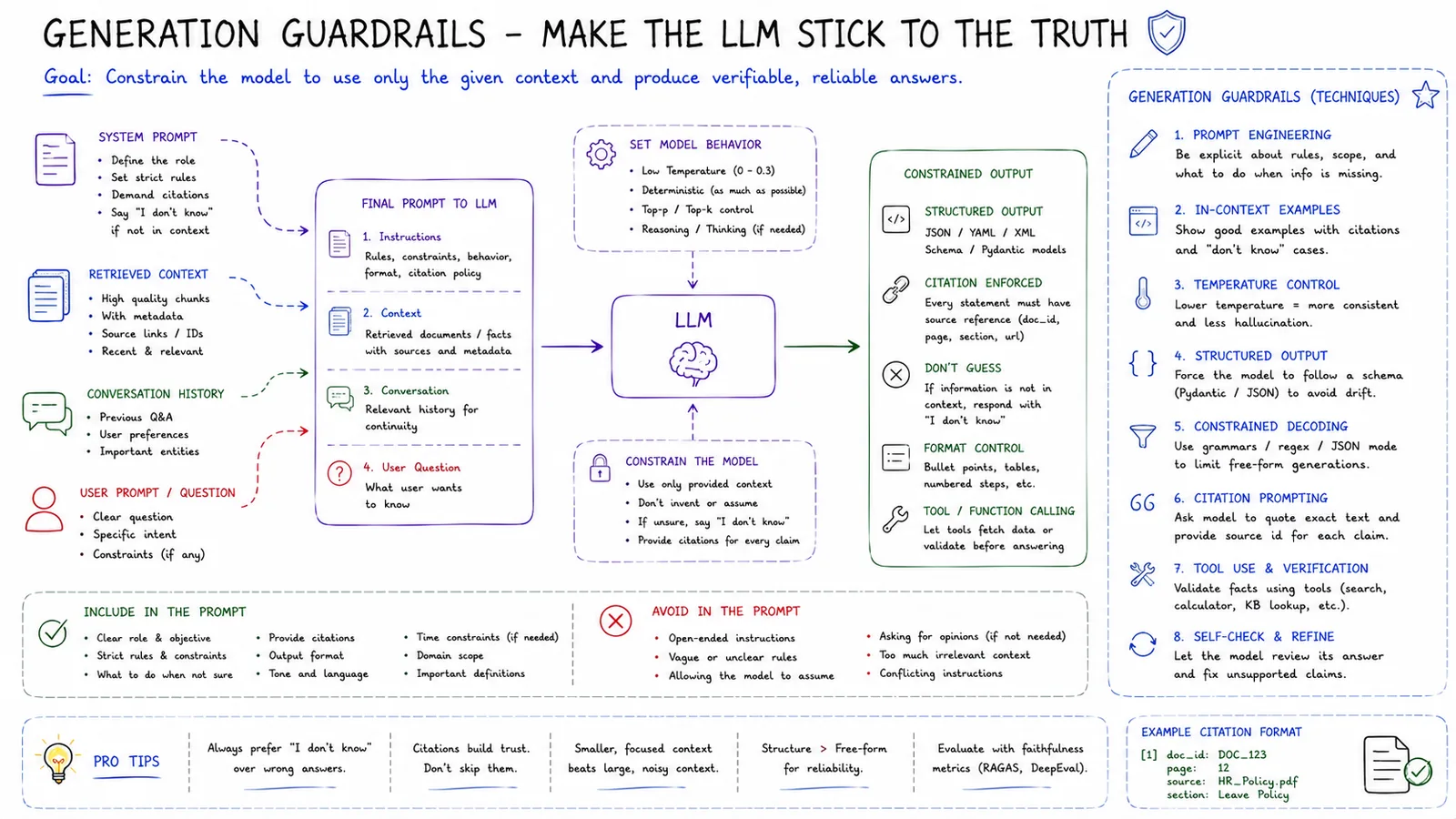
Generation guardrails make the LLM stick to the truth. The goal is to constrain the model to use only the given context and produce verifiable, reliable answers.
In simple terms
Constrain the model to answer only from the provided context — and say 'I don't know' otherwise.
How it works
- 1Assemble a final prompt with clear rules, high-quality context and a citation policy.
- 2Set model behaviour: low temperature, top-p control, reasoning if needed.
- 3Constrain the model: use only provided context; if unsure, say 'I don't know'.
- 4Produce constrained output: structured output, citations for every claim.
- 5Self-check and refine before returning the answer.
Key points
- Techniques: prompt engineering, in-context examples, low temperature, structured output, constrained decoding.
- Every claim should cite its source (doc id, page, section).
- Prefer 'I don't know' over a wrong answer; don't skip citations.
- Validate outputs and add self-check or refinement.
Why it matters
Guardrails are how you make a RAG system trustworthy — grounding answers in context, citing sources and refusing to guess reduces hallucination dramatically.
Frequently asked questions
- How do guardrails reduce hallucination?
- By forcing the model to answer only from provided context, cite claims and say 'I don't know' when unsure.
- What is constrained decoding?
- Using grammars, regex or JSON mode to limit the model's output to a valid, expected format.
More in RAG & Retrieval (Enterprise)
Where Hallucinations Come From
Failures across the query, retrieval and model layers.
RAG Retrieval Optimization Layer
Retrieve the right context with high recall and relevance.
RAG: Retrieval Re-ranking
Re-rank retrieved docs to keep only the most relevant.
RAG Optimization 1 · Hybrid Search
Keyword + semantic search for higher recall.
RAG Optimization 2 · Re-ranking
Find the most relevant docs before the LLM.
RAG Optimization 3 · Context Pruning
Remove noise; keep only what matters.