
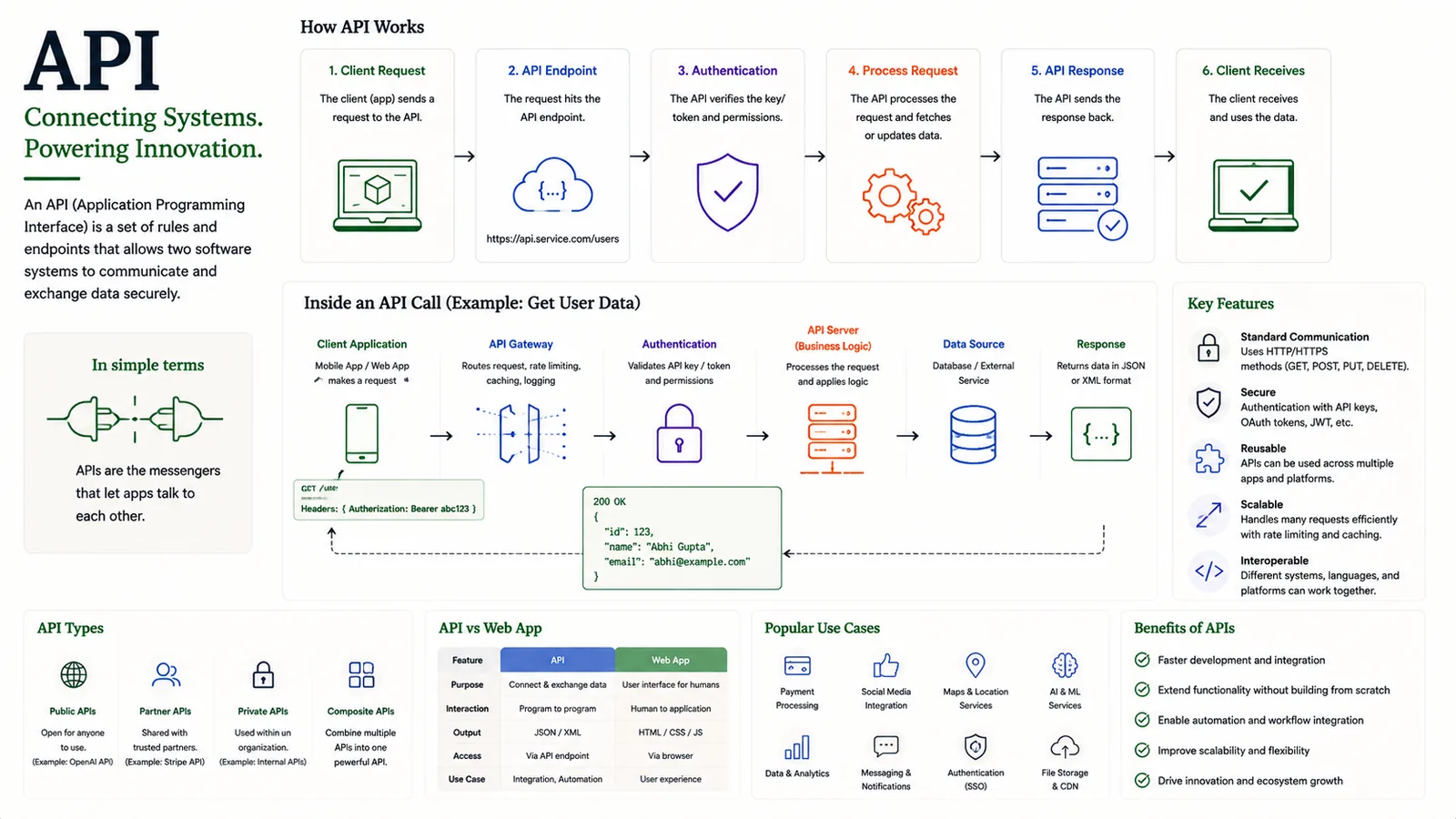
An API (Application Programming Interface) is a set of rules and endpoints that lets two software systems communicate and exchange data securely. APIs are the messengers that let apps talk to each other.
In simple terms
The messengers that let different software systems talk to each other.
How it works
- 1Client request: the client (app) sends a request to the API.
- 2API endpoint: the request hits the API endpoint.
- 3Authentication: the API verifies the key, token and permissions.
- 4Process request: the API processes the request and fetches or updates data.
- 5API response: the API sends the response back (often JSON).
- 6Client receives: the client receives and uses the data.
Key points
- Uses standard methods (GET, POST, PUT, DELETE) over HTTP/HTTPS.
- Secured with API keys, OAuth, JWT and more.
- Reusable across multiple apps and platforms.
- Scalable — handles many requests with caching and rate limiting.
Why it matters
APIs are how modern software — including AI tools and agents — connects to services and data. Understanding them is essential for building anything that integrates with the outside world.
Frequently asked questions
- Why do AI agents need APIs?
- Agents call APIs to take real actions and fetch real data — search, databases, email and more.
- What is an endpoint?
- A specific URL the API exposes for a particular action, like /users to get user data.
More in Agents, Tools & Protocols
AI Agent
An autonomous system that perceives, reasons and acts.
LangChain
A framework for building LLM-powered applications.
MCP (Model Context Protocol)
The universal adapter connecting AI to tools and data.
WebMCP (Web Model Context Protocol)
MCP for the web — AI in the browser using online tools.
Fine Tuning
Adapt a pre-trained model to your specific data and task.
Fine-Tuning (Deep Dive)
The full fine-tuning workflow and hyperparameters.