
10 · Identity, Policy & Security
Fine-grained, context-aware authorization with Cedar.
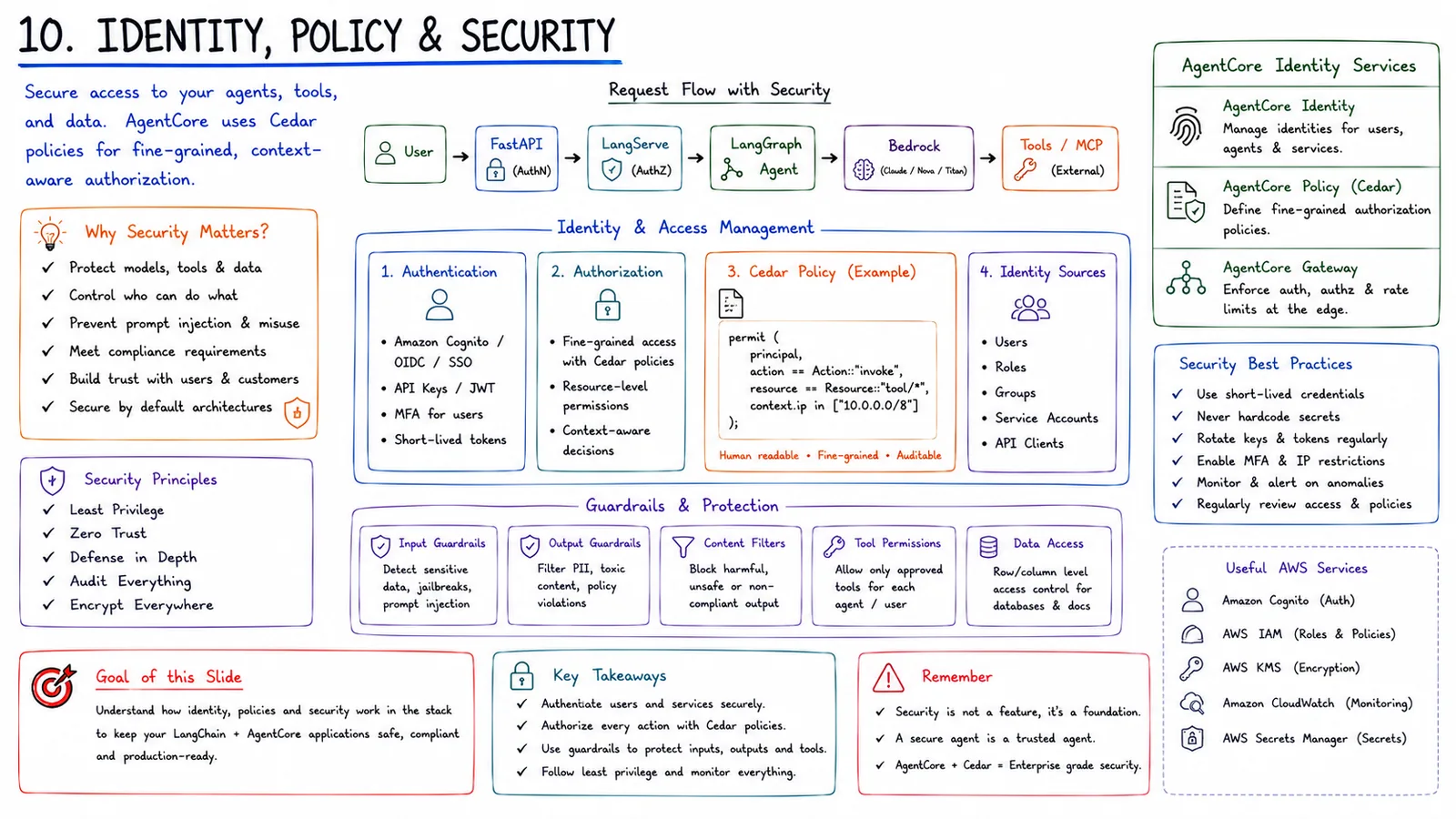
This covers securing access to your agents, tools and data. AgentCore uses Cedar policies for fine-grained, context-aware authorization, plus guardrails against prompt injection and data leaks.
In simple terms
Authenticate users, authorize every action with fine-grained policies, and guard inputs and outputs.
How it works
- 1Authentication: verify users via Cognito/OIDC/SSO, API keys or JWT.
- 2Authorization: fine-grained, context-aware access using Cedar policies.
- 3Guardrails: input guardrails detect sensitive data and jailbreaks; output guardrails filter harmful or non-compliant content.
- 4Tool permissions and data access controls limit what agents can reach.
Key points
- Security principles: least privilege, zero trust, defense in depth, audit everything.
- Cedar policies are human-readable, fine-grained and auditable.
- Never hardcode secrets; rotate keys, enable MFA and monitor for anomalies.
- A secure agent is a trusted agent — security is a foundation, not a feature.
Why it matters
Agents can take real actions, so weak security is dangerous. Fine-grained authorization and guardrails keep agents safe, compliant and production-ready.
Frequently asked questions
- What are Cedar policies?
- A human-readable, auditable policy language for fine-grained, context-aware authorization in AgentCore.
- How do guardrails help?
- They filter malicious inputs (prompt injection) and unsafe or non-compliant outputs.
More in Production AI Stack (2026)
1 · The Big Picture
The complete end-to-end production AI stack (2026).
2 · User Request Lifecycle
How one request flows through the whole system.
3 · LangChain Ecosystem
How LangChain, LangGraph, LangServe and LangSmith fit together.
4 · LangGraph Orchestration
Stateful, multi-step agent workflows.
5 · AWS Bedrock Integration
How LangChain talks to models through Amazon Bedrock.
6 · Amazon AgentCore
The enterprise runtime for LangChain/LangGraph agents.