
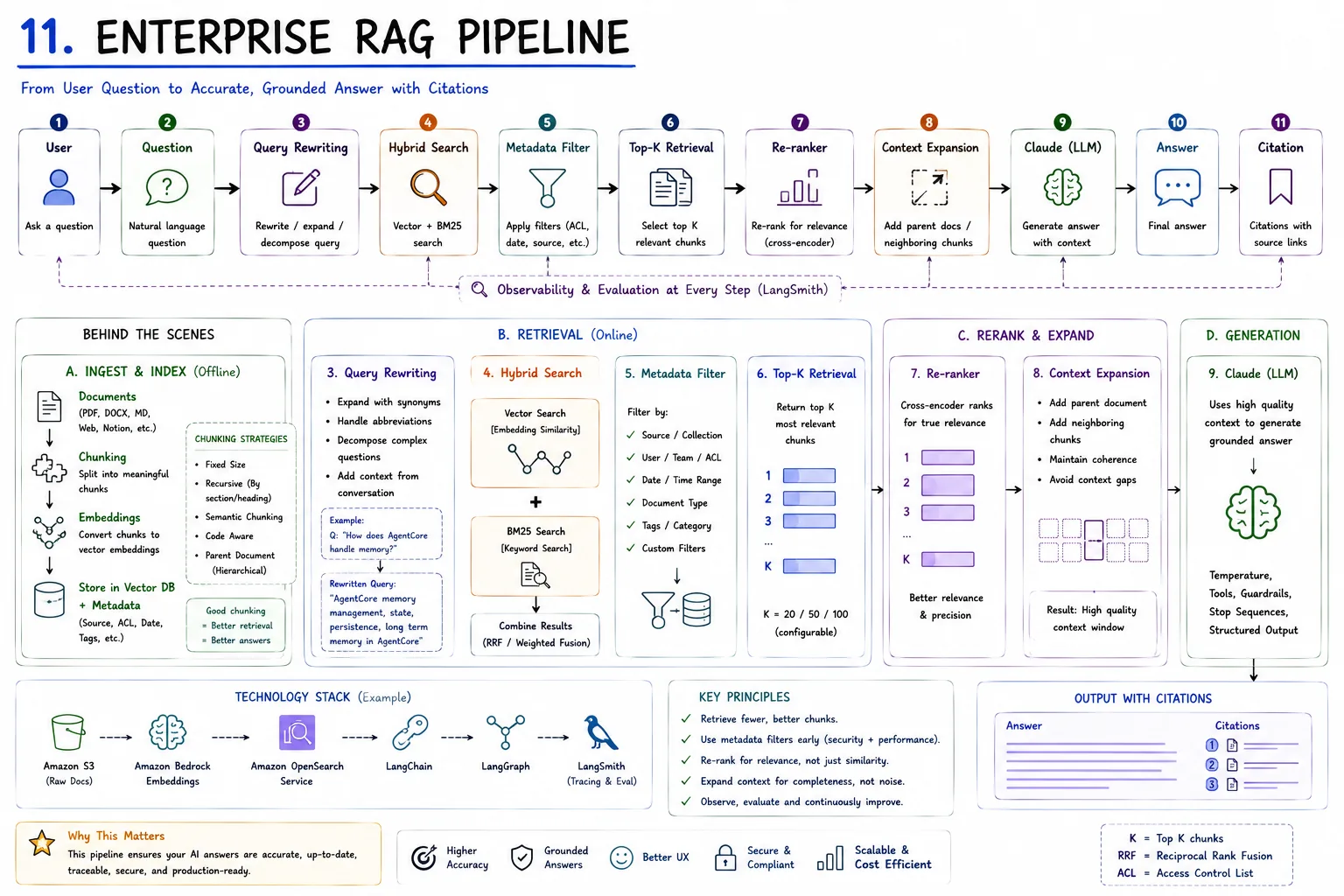
This is an enterprise RAG pipeline that takes a user question and returns an accurate, grounded answer with citations. It shows every step from query rewriting to retrieval, reranking and generation.
In simple terms
From question to grounded, cited answer — the full enterprise RAG pipeline.
How it works
- 1Rewrite the query (expand, decompose) and run hybrid search (vector + BM25).
- 2Apply metadata filters (access control, date, type) and retrieve the top-K chunks.
- 3Re-rank with a cross-encoder for relevance and expand context with parent/neighbouring chunks.
- 4Generate the answer with the LLM (Bedrock) using the high-quality context.
- 5Return the final answer with citations to source links.
Key points
- Offline: documents are chunked, embedded and stored with metadata.
- Online: query rewriting → hybrid search → filter → rerank → expand → generate.
- Observability and evaluation run at every step (LangSmith).
- Key principles: retrieve fewer, better chunks; filter early; rerank for relevance.
Why it matters
A well-built RAG pipeline is what makes enterprise AI answers accurate, up-to-date, traceable and secure — the difference between a demo and production.
Frequently asked questions
- What is hybrid search?
- Combining keyword (BM25) and vector (semantic) search for higher recall than either alone.
- Why re-rank?
- A cross-encoder scores query+document together, picking the truly most relevant chunks before the LLM sees them.
More in Production AI Stack (2026)
1 · The Big Picture
The complete end-to-end production AI stack (2026).
2 · User Request Lifecycle
How one request flows through the whole system.
3 · LangChain Ecosystem
How LangChain, LangGraph, LangServe and LangSmith fit together.
4 · LangGraph Orchestration
Stateful, multi-step agent workflows.
5 · AWS Bedrock Integration
How LangChain talks to models through Amazon Bedrock.
6 · Amazon AgentCore
The enterprise runtime for LangChain/LangGraph agents.