
11 · Enterprise RAG Pipeline (v2)
Alternate layout of the enterprise RAG pipeline.
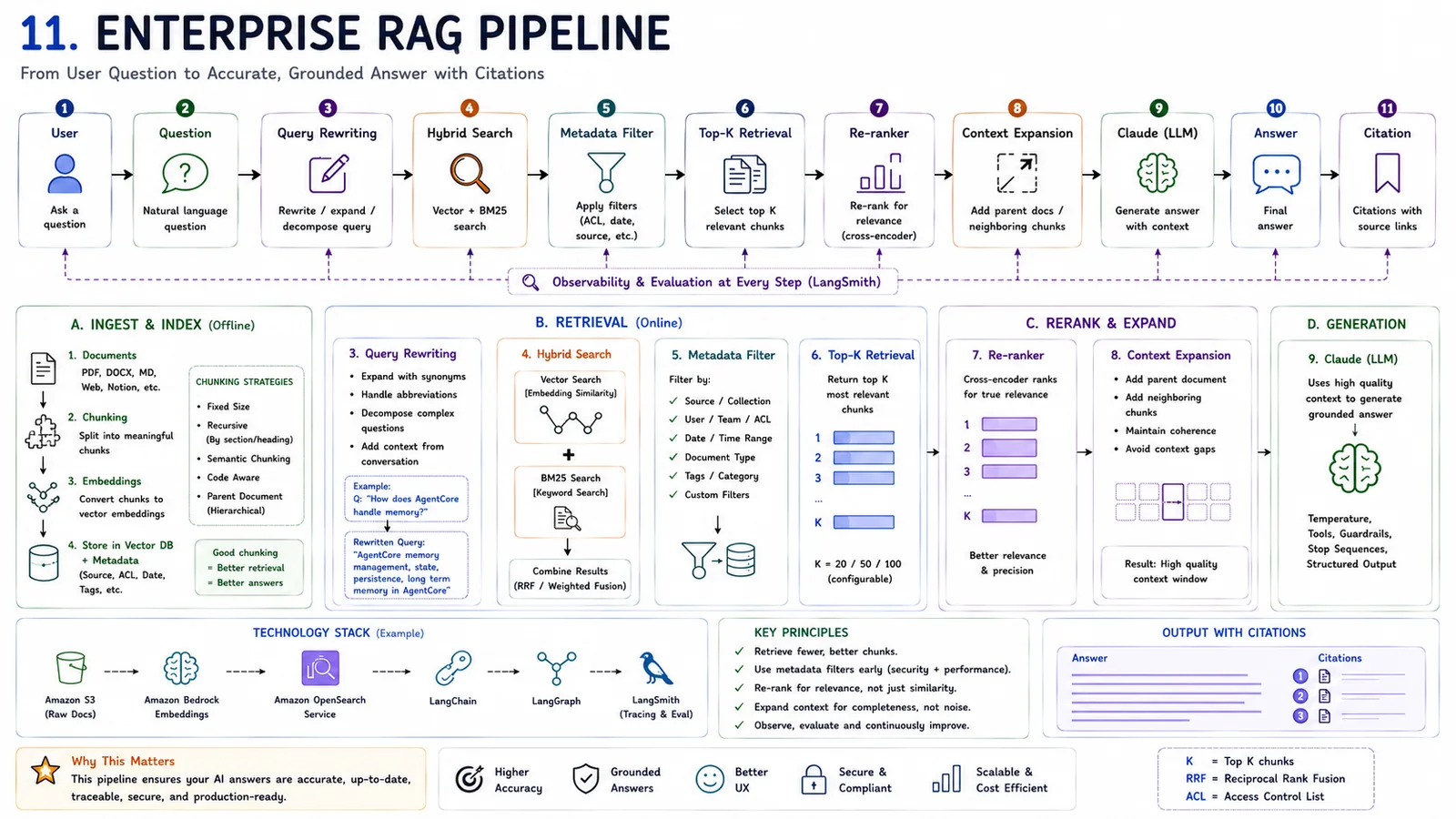
An alternate layout of the enterprise RAG pipeline — the same question-to-grounded-answer flow, drawn to emphasise the offline ingest and online retrieval stages side by side.
In simple terms
The enterprise RAG pipeline again, with ingest/index and online retrieval laid out together.
How it works
- 1Ingest & index (offline): chunk documents, embed them and store with metadata.
- 2Rewrite the query and run hybrid search (vector + BM25).
- 3Filter by metadata, retrieve top-K, then re-rank with a cross-encoder.
- 4Expand context with parent/neighbouring chunks.
- 5Generate the grounded answer with the LLM and return citations.
Key points
- Same pipeline as the primary diagram, different visual emphasis.
- Separates the offline indexing stage from the online answering stage.
- Reciprocal Rank Fusion (RRF) merges keyword and vector results.
- Access Control Lists (ACL) enforce who can retrieve what.
Why it matters
Seeing ingest and retrieval side by side clarifies that RAG has two halves: preparing the knowledge base offline and answering questions online.
Frequently asked questions
- What is RRF?
- Reciprocal Rank Fusion — a way to merge keyword and vector search rankings into one combined result.
- Why separate offline and online?
- Indexing happens once (offline); answering happens per query (online). They have different performance needs.
More in Production AI Stack (2026)
1 · The Big Picture
The complete end-to-end production AI stack (2026).
2 · User Request Lifecycle
How one request flows through the whole system.
3 · LangChain Ecosystem
How LangChain, LangGraph, LangServe and LangSmith fit together.
4 · LangGraph Orchestration
Stateful, multi-step agent workflows.
5 · AWS Bedrock Integration
How LangChain talks to models through Amazon Bedrock.
6 · Amazon AgentCore
The enterprise runtime for LangChain/LangGraph agents.