
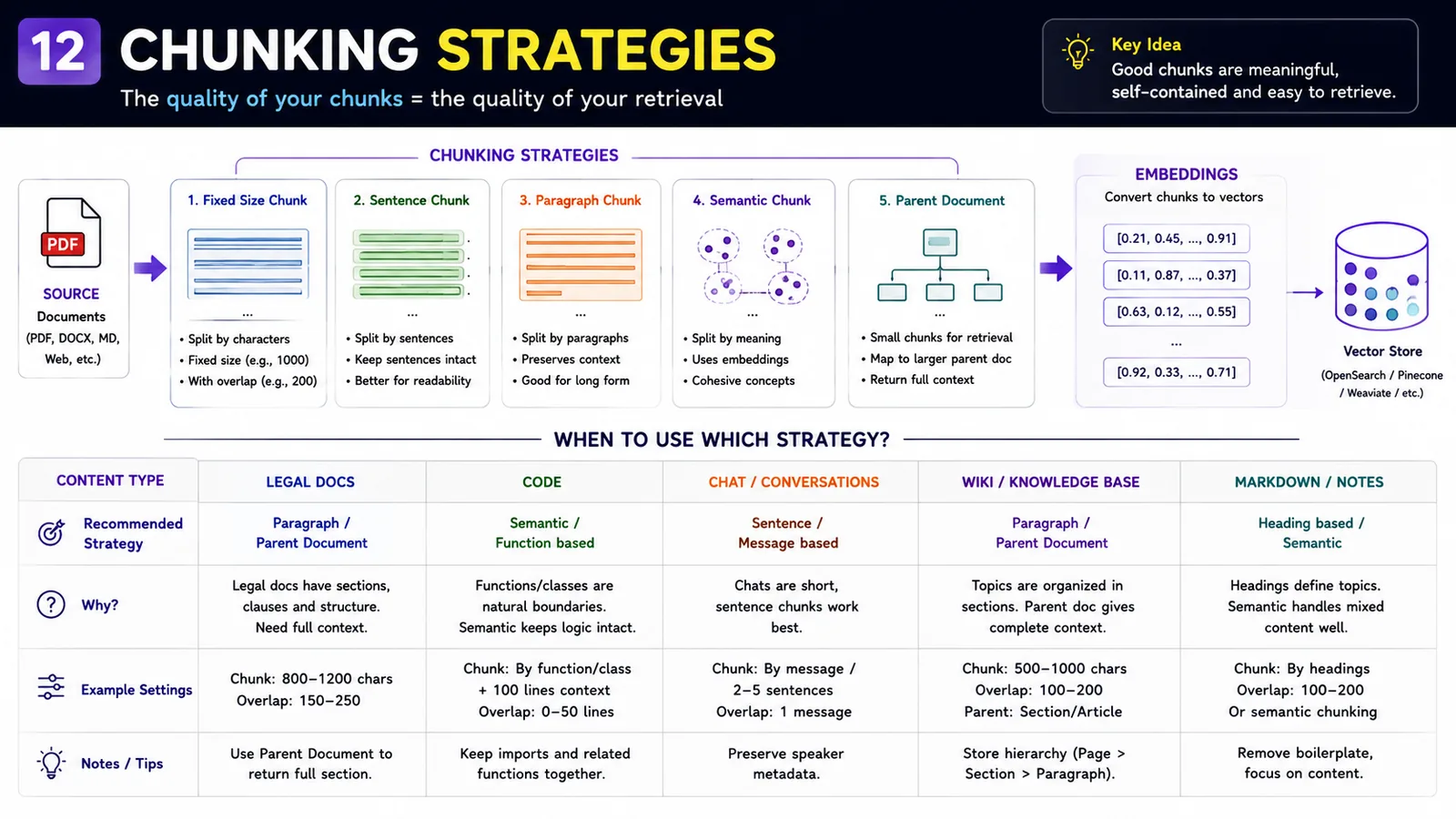
The quality of your chunks is the quality of your retrieval. This compares chunking strategies and when to use each, because good chunks are meaningful, self-contained and easy to retrieve.
In simple terms
How you split documents into chunks decides how well retrieval works.
How it works
- 1Fixed-size chunking: split by characters with overlap — simple and fast.
- 2Sentence chunking: split by sentences to keep them intact.
- 3Paragraph chunking: preserves context for longer form.
- 4Semantic chunking: split by meaning using embeddings.
- 5Parent-document: small chunks for retrieval mapped to a larger parent for context.
Key points
- Match the strategy to content: legal docs → paragraph/parent; code → function-based; chat → message-based.
- Typical settings: 500–1200 chars with 100–250 overlap.
- Overlap prevents meaning that spans a boundary from being lost.
- Good chunks are meaningful, self-contained and retrievable.
Why it matters
Chunking is an underrated lever: poor chunks wreck retrieval no matter how good the model is. The right strategy makes RAG precise and grounded.
Frequently asked questions
- What is chunk overlap?
- Repeating some text between adjacent chunks so ideas spanning a boundary aren't lost.
- Which strategy is best?
- It depends on content type — semantic or parent-document for context-heavy docs, function-based for code.
More in Production AI Stack (2026)
1 · The Big Picture
The complete end-to-end production AI stack (2026).
2 · User Request Lifecycle
How one request flows through the whole system.
3 · LangChain Ecosystem
How LangChain, LangGraph, LangServe and LangSmith fit together.
4 · LangGraph Orchestration
Stateful, multi-step agent workflows.
5 · AWS Bedrock Integration
How LangChain talks to models through Amazon Bedrock.
6 · Amazon AgentCore
The enterprise runtime for LangChain/LangGraph agents.