
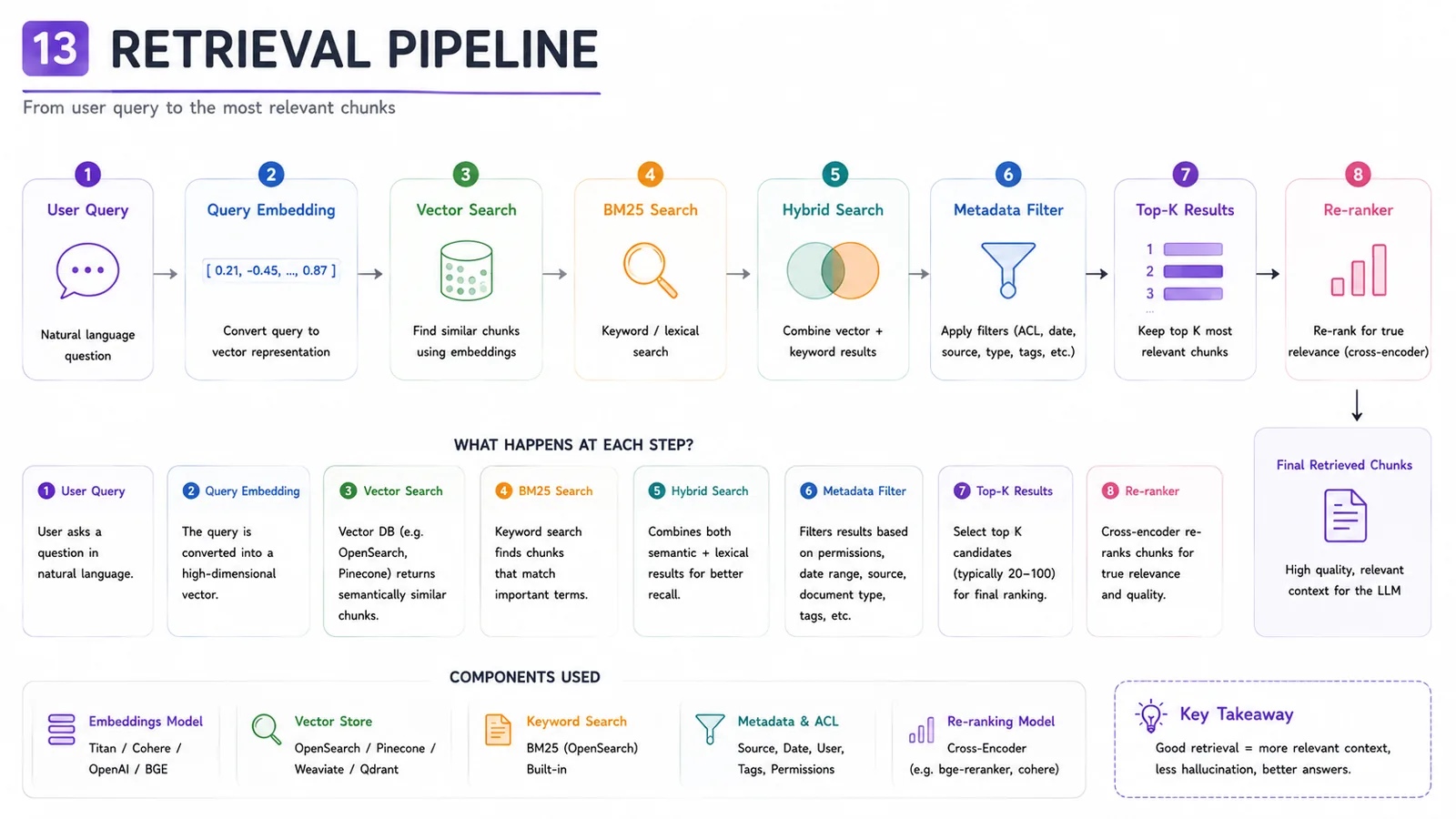
This retrieval pipeline goes from a user query to the most relevant chunks, combining vector search, keyword search, filtering, top-K selection and reranking.
In simple terms
From user query to the most relevant chunks, step by step.
How it works
- 1User query → query embedding (convert to a vector).
- 2Vector search finds semantically similar chunks; BM25 finds keyword matches.
- 3Hybrid search combines both for better recall.
- 4Metadata filter applies ACL, date, source and type constraints.
- 5Top-K results are kept, then a cross-encoder re-ranks for true relevance.
Key points
- Combines semantic and lexical search for recall and precision.
- Metadata filtering enforces permissions and narrows results.
- Re-ranking uses a cross-encoder for final relevance.
- Components: embeddings model, vector store, keyword search, re-ranker.
Why it matters
Good retrieval means more relevant context, less hallucination and better answers. This pipeline is the retrieval half of any strong RAG system.
Frequently asked questions
- Why both vector and BM25?
- Vector catches meaning; BM25 catches exact terms like IDs and names. Together they maximise recall.
- What is top-K?
- Keeping the K most relevant candidates (e.g. 20–100) before final ranking.
More in Production AI Stack (2026)
1 · The Big Picture
The complete end-to-end production AI stack (2026).
2 · User Request Lifecycle
How one request flows through the whole system.
3 · LangChain Ecosystem
How LangChain, LangGraph, LangServe and LangSmith fit together.
4 · LangGraph Orchestration
Stateful, multi-step agent workflows.
5 · AWS Bedrock Integration
How LangChain talks to models through Amazon Bedrock.
6 · Amazon AgentCore
The enterprise runtime for LangChain/LangGraph agents.