
14 · Prompt Engineering Architecture
Context + instruction + memory = better answers.
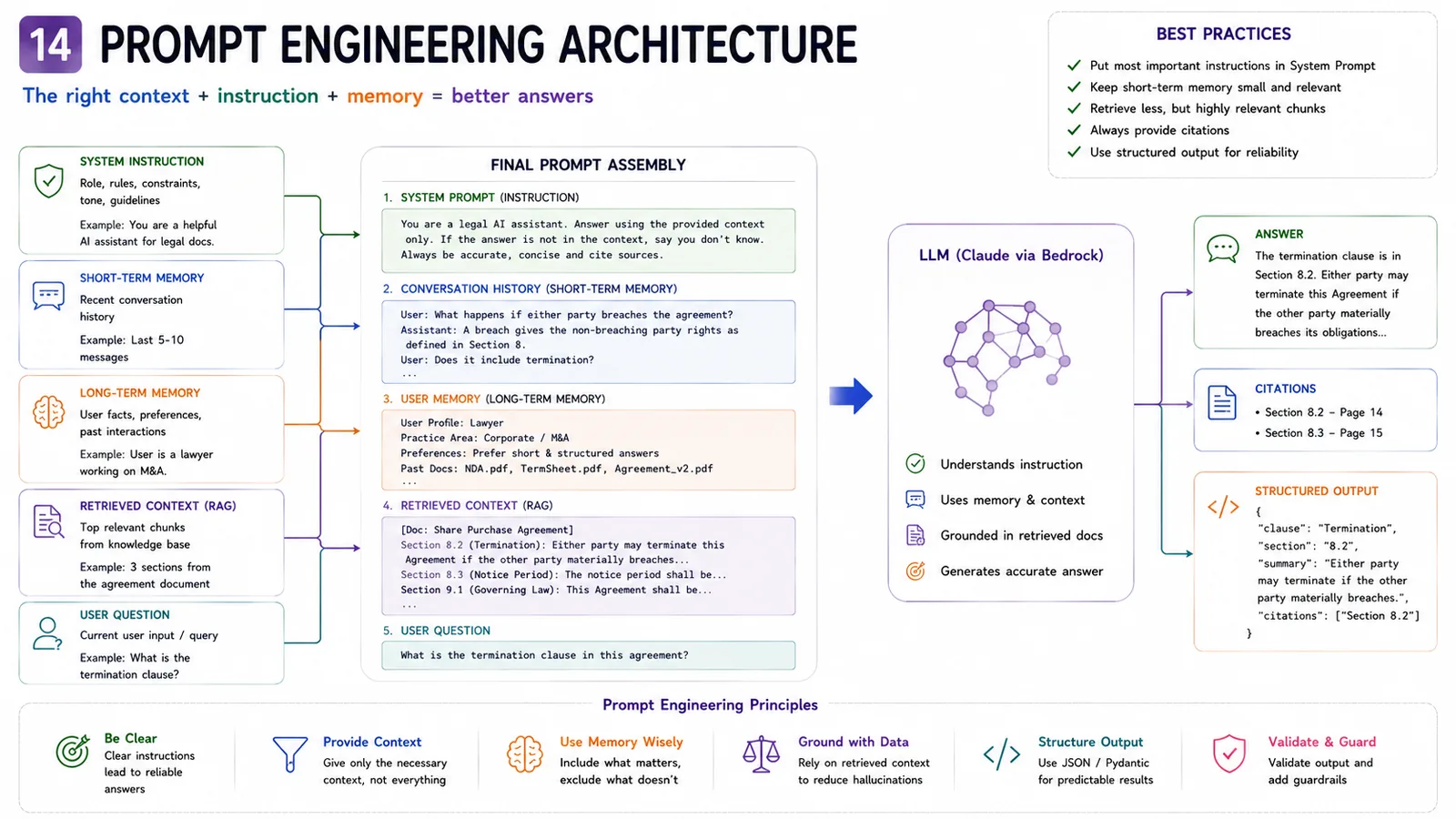
This shows a prompt engineering architecture for enterprise agents: the right context plus instruction plus memory equals better answers. It details how a final prompt is assembled from many sources.
In simple terms
Assemble the final prompt from system instruction, memory, retrieved context and the user question.
How it works
- 1System instruction: role, rules, constraints and tone.
- 2Short-term memory: recent conversation history.
- 3Long-term/user memory: user facts, preferences and past interactions.
- 4Retrieved context (RAG): top relevant chunks from the knowledge base.
- 5User question: assembled into the final prompt sent to the LLM.
Key points
- Put the most important instructions in the system prompt.
- Keep short-term memory small and relevant; retrieve less, but highly relevant, context.
- Always provide citations and use structured output for reliability.
- Principles: be clear, provide context, use memory wisely, ground with data, structure output.
Why it matters
In enterprise agents, the prompt is assembled programmatically from many sources. Getting that assembly right — instruction, memory, context — is what produces accurate, grounded answers.
Frequently asked questions
- What goes into a production prompt?
- System instruction, short- and long-term memory, retrieved RAG context, and the user's question.
- How do I keep prompts reliable?
- Prioritise the system instruction, retrieve only relevant context, cite sources and enforce structured output.
More in Production AI Stack (2026)
1 · The Big Picture
The complete end-to-end production AI stack (2026).
2 · User Request Lifecycle
How one request flows through the whole system.
3 · LangChain Ecosystem
How LangChain, LangGraph, LangServe and LangSmith fit together.
4 · LangGraph Orchestration
Stateful, multi-step agent workflows.
5 · AWS Bedrock Integration
How LangChain talks to models through Amazon Bedrock.
6 · Amazon AgentCore
The enterprise runtime for LangChain/LangGraph agents.