
15 · Streaming Architecture
Real-time streaming for better UX and lower latency.
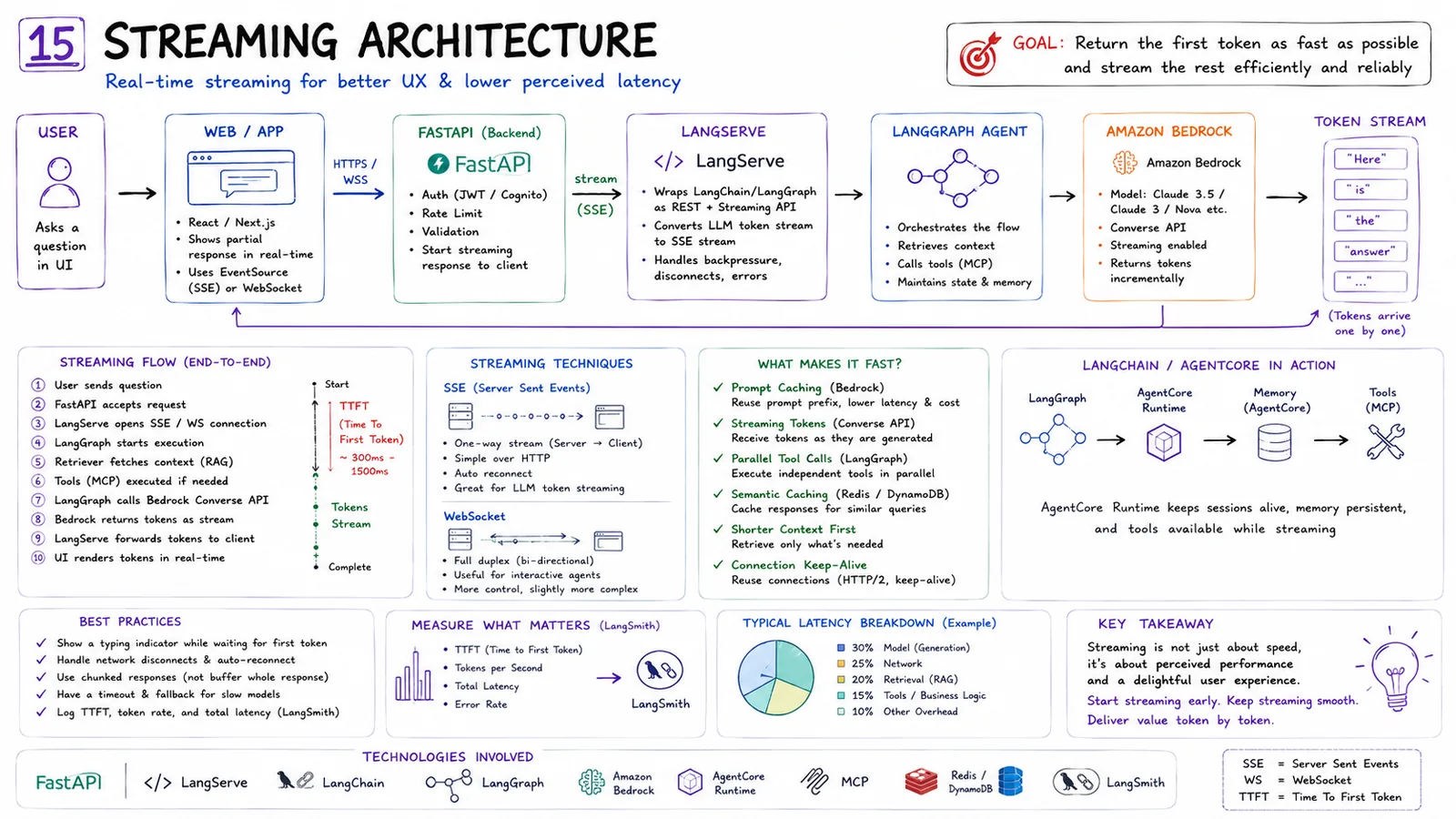
This is a streaming architecture for real-time UX and lower perceived latency. The goal: return the first token as fast as possible and stream the rest efficiently and reliably.
In simple terms
Stream tokens as they're generated so users see a response instantly instead of waiting.
How it works
- 1User asks a question in the UI.
- 2FastAPI accepts the request; LangServe opens an SSE/WebSocket connection.
- 3LangGraph starts execution and retrieves context (RAG).
- 4Bedrock returns tokens as a stream via the Converse API.
- 5LangServe forwards tokens to the client, which renders them one by one.
Key points
- SSE (server-sent events) is simple one-way streaming; WebSockets are bidirectional.
- Prompt caching and shorter context reduce time-to-first-token.
- Parallel tool calls and semantic caching speed things up.
- Measure TTFT, tokens per second and total latency.
Why it matters
Streaming isn't just about speed — it's about perceived responsiveness. Showing the first token fast makes an AI feel instant, even when total generation takes seconds.
Frequently asked questions
- What is TTFT?
- Time To First Token — how long until the first piece of the response appears. Lower feels much faster.
- SSE or WebSocket?
- SSE for simple one-way token streaming; WebSockets when you need two-way, interactive communication.
More in Production AI Stack (2026)
1 · The Big Picture
The complete end-to-end production AI stack (2026).
2 · User Request Lifecycle
How one request flows through the whole system.
3 · LangChain Ecosystem
How LangChain, LangGraph, LangServe and LangSmith fit together.
4 · LangGraph Orchestration
Stateful, multi-step agent workflows.
5 · AWS Bedrock Integration
How LangChain talks to models through Amazon Bedrock.
6 · Amazon AgentCore
The enterprise runtime for LangChain/LangGraph agents.