
30 · Choosing the Right Agent Architecture
A decision framework for pattern, stack and services.
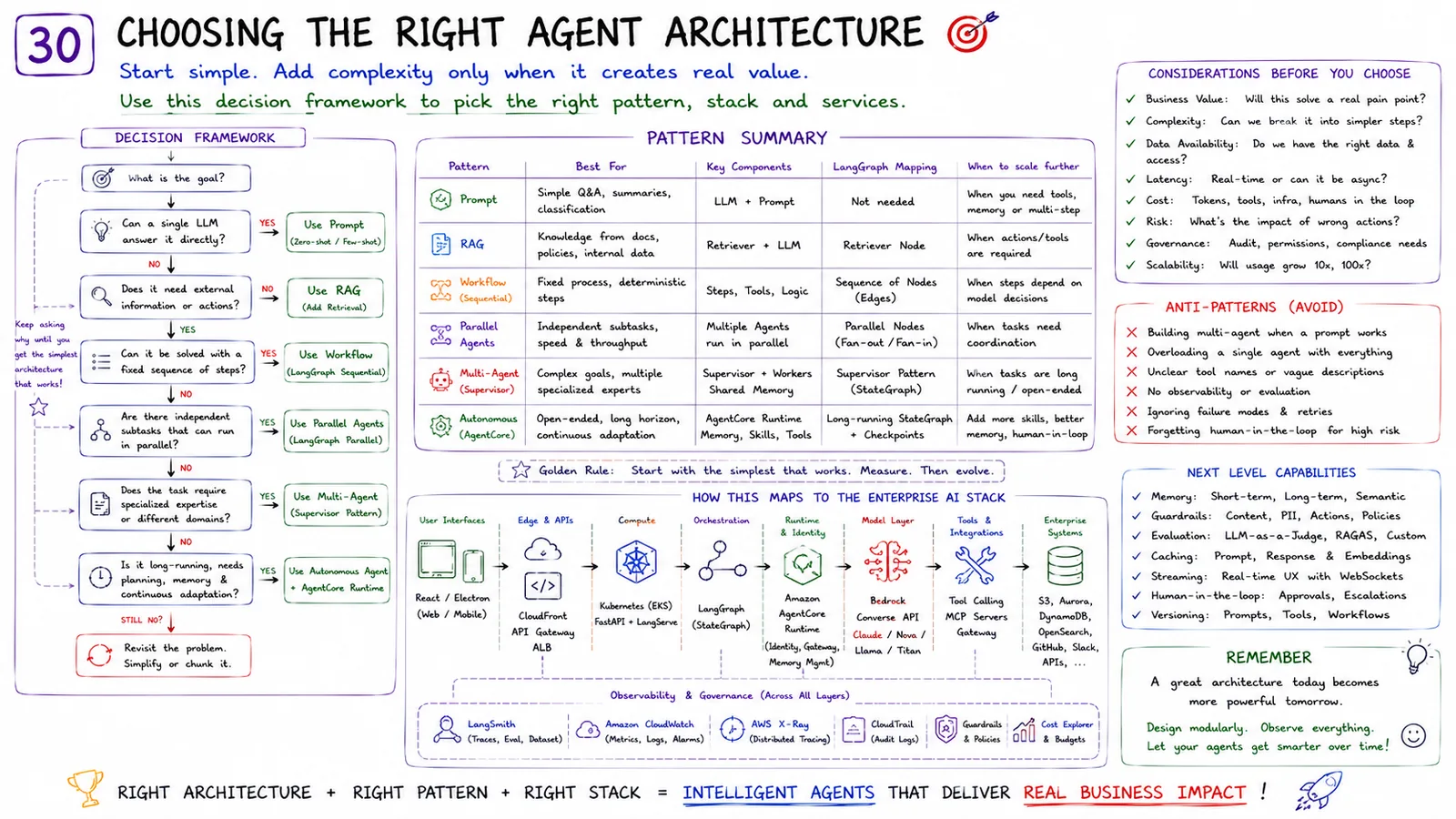
This is a decision framework for choosing the right agent architecture: start simple and add complexity only when it creates real value. Use it to pick the right pattern, stack and services.
In simple terms
A step-by-step framework to pick the simplest architecture that solves your problem.
How it works
- 1Can a single LLM answer directly? Use a prompt.
- 2Does it need external information? Add RAG.
- 3Is it a fixed sequence of steps? Use a workflow (LangGraph).
- 4Are there independent subtasks? Use parallel agents.
- 5Open-ended, long-horizon, continuous adaptation? Use autonomous agents with AgentCore.
Key points
- Pattern summary maps each pattern to its best use case and LangGraph mapping.
- Consider business value, complexity, latency, cost, risk and governance before choosing.
- Anti-patterns to avoid: multi-agent when one works, over-engineering, ignoring failure modes.
- Right architecture + right pattern + right stack = agents that deliver real impact.
Why it matters
Most failures come from choosing the wrong complexity. A decision framework keeps you on the simplest effective architecture and away from costly over-engineering.
Frequently asked questions
- What's the golden rule?
- Start with the simplest thing that works, measure, then evolve — don't reach for multi-agent by default.
- When do I need autonomous agents?
- For open-ended, long-horizon goals that need continuous planning, memory and adaptation.
More in Production AI Stack (2026)
1 · The Big Picture
The complete end-to-end production AI stack (2026).
2 · User Request Lifecycle
How one request flows through the whole system.
3 · LangChain Ecosystem
How LangChain, LangGraph, LangServe and LangSmith fit together.
4 · LangGraph Orchestration
Stateful, multi-step agent workflows.
5 · AWS Bedrock Integration
How LangChain talks to models through Amazon Bedrock.
6 · Amazon AgentCore
The enterprise runtime for LangChain/LangGraph agents.