
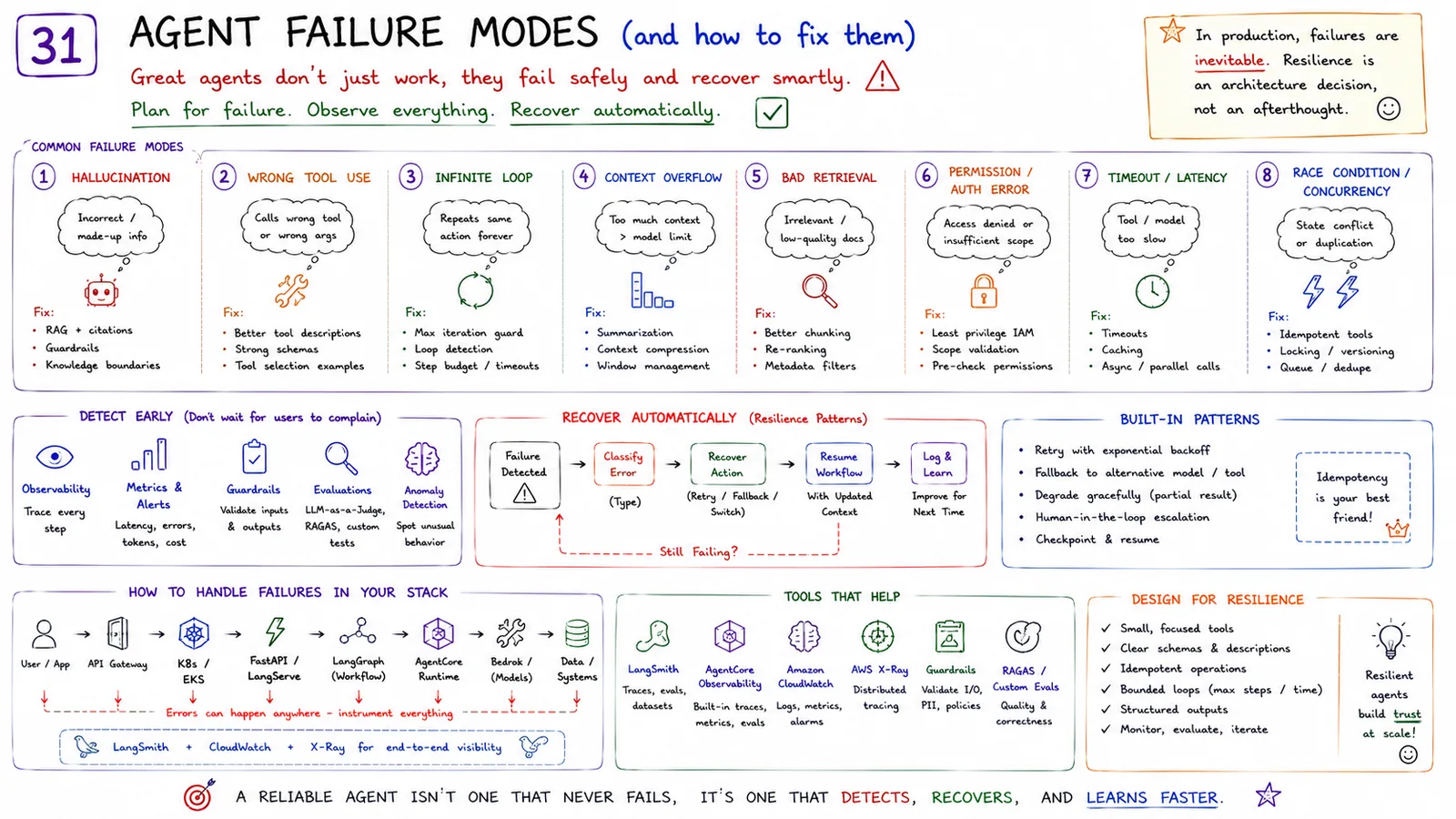
Great agents don't just work — they fail safely and recover smartly. This lists common agent failure modes and how to fix them, because in production, failures are inevitable.
In simple terms
Plan for failure: detect early, recover automatically, and learn from it.
How it works
- 1Common failure modes: hallucination, wrong tool use, infinite loops, context overflow, bad retrieval, permission/auth errors, timeouts, race conditions.
- 2Detect early with observability, metrics, evaluations and anomaly detection.
- 3Recover automatically with retries, fallbacks and workflow resumption.
- 4Use built-in patterns: retry with backoff, fallback models, human-in-the-loop escalation, checkpoints.
Key points
- Fix hallucinations with RAG, citations and guardrails; fix loops with max iterations and step budgets.
- Idempotency is your best friend for safe retries.
- Design for resilience: small focused tools, clear descriptions, bounded loops, structured output.
- A reliable agent isn't one that never fails — it's one that detects, recovers and learns faster.
Why it matters
Production agents will hit failures. Designing for detection and automatic recovery is what makes them trustworthy and safe rather than brittle.
Frequently asked questions
- What are the most common failure modes?
- Hallucination, wrong tool use, infinite loops, context overflow, bad retrieval, auth errors and timeouts.
- How do I make retries safe?
- Design tools to be idempotent, so re-running them doesn't cause duplicate or harmful effects.
More in Production AI Stack (2026)
1 · The Big Picture
The complete end-to-end production AI stack (2026).
2 · User Request Lifecycle
How one request flows through the whole system.
3 · LangChain Ecosystem
How LangChain, LangGraph, LangServe and LangSmith fit together.
4 · LangGraph Orchestration
Stateful, multi-step agent workflows.
5 · AWS Bedrock Integration
How LangChain talks to models through Amazon Bedrock.
6 · Amazon AgentCore
The enterprise runtime for LangChain/LangGraph agents.